
Commercialization
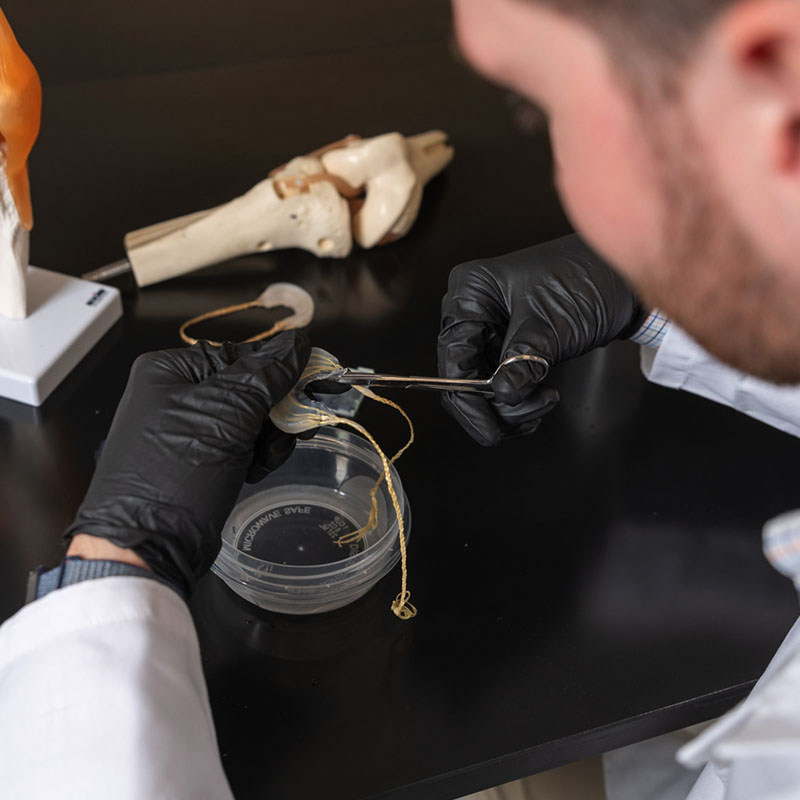
IBB helps bio researchers move innovations from lab to market, offering guidance on startups, funding, and commercialization to create societal impact and improve human health.
Questions
For questions about commercialization at IBB, contact Cynthia Sundell and Harold Solomon.
BioHIVE
BioHIVE is your source for news, events, startup features, and more from IBB commercialization. Subscribe today and stay connected!
Previous Seminar Recordings
Bio LaunchPad Seminar
"Humanizing Deep Tech: Transforming Breakthrough Technologies into Real-World Solutions"
James Wang, General Partner at Creative Ventures
March 3, 2026
Video Transcript
I'm Harold Solomon. I'm with Quadrant I and a member of the IBV family. And happy to welcome James Chang, an alum, in the first cohort of our online Masters for Computer Science. So that's its own story. James has a really interesting background. and I only met him because we're a hard tech university primarily and we never have enough input from hard tech investors. So I was looking for hard tech investors. And I'm going to show you a little bit of that search, my journey to find James as a way of teaching how you view an investor as, I'm going to say it, worthy of your attention because there are many who will wear that label, hold that flag, and haven't really earned it. James really has in an exceptional way. I found him on LinkedIn looking for hard tech, deep tech investing, using search terms that you don't know how to do. That's not the mystery.
The background was phenomenal, and it was unusual because he started out of school, or I guess out of undergrad with that nonprofit and then to go from a nonprofit to one of the world's iconic hedge funds, Bridgewater, I don't know if any of you follow Ray Dalio, but that doesn't make sense. You just don't see a trajectory. You come out of some advanced math program or some amazing business school. You might, if you're top of your heap, you'll end up at Bridgewater. That background didn't make sense and it got more interesting.
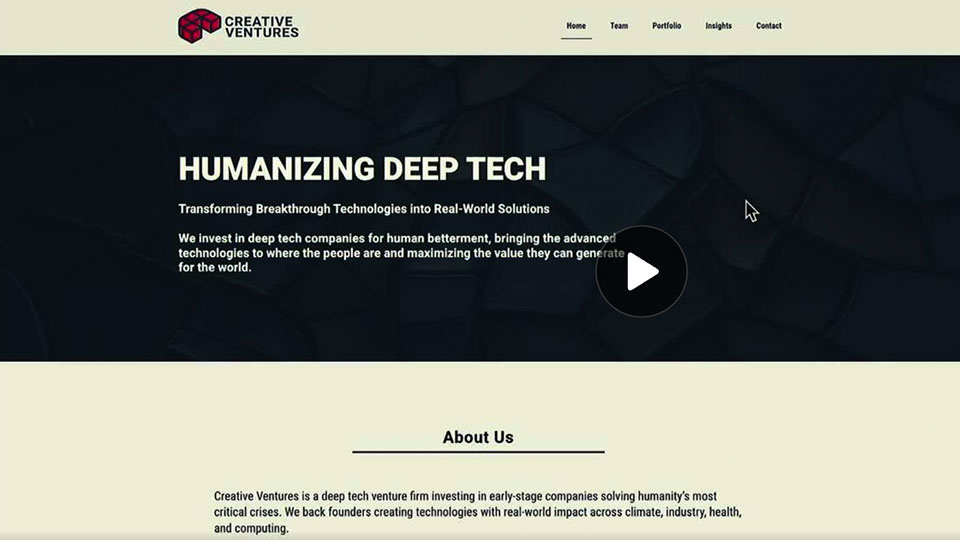
started companies and then there's a venture fund and this is where i want to stop and pause and teach but by way of introducing as a way of introducing james so i pulled up his fund and you can see that creative ventures and the only thing i want to show you on this is when you're looking at a venture fund if you don't see team like who's on the team and you look at their backgrounds, and then you don't see portfolio, you're done. You can now go home. You've already wasted 15 seconds. Don't make it worse. Now, when you look at portfolio, you may or may not recognize the names. So another way to triangulate that, you can look at each company, see who the other investors are, or you could go to a tool that we have free access to, and many people do, but nobody uses it. It's at our library.
This is, if you go to library.gottech.edu and look for CB Insights, like Charlie Baker Insights, and you key in Creative Ventures, it's going to show you a lot of things related to creative and ventures, so their search is not great. But once you isolate for investors, this is who you will find. And then it gets really impressive because you see how much they've been investing over a five -year horizon, which is already some durability. And then I'm going to make this bigger. Does this work, Randy? Yeah. You look at the number of and types of investors in their syndicate, in this case, a Series B2 round. So this could have been three or four financings after their seed investment. When you see all these companies and you look at them, some of these are really notable. Maybe you know Mark Cuban from Shark Tank, but Circano is really, really notable.
Tiger Global is, you have to read about that. You have to tell me about that. I've never worked with them. That must be something else. Anzu Partners, many of you here may know. Hank Boat, they have a person here in town. But they're a really thoughtful, hard-tack investor. Now you know, by seeing the number of deals he's been in, who follows his seed investments. you know this is a very credible, very excellent, thoughtful investor. So with that, I'll turn it over to James. You've got your own mic, right? Yeah, I think so. All right, sounds good. And, yeah, I think Harold gives me too much credit. I was here for OMSCS and tried to do various ones on campus, off campus, and stuff. But it took me five years to graduate. So, you know. Can you guys hear him okay? Okay. Yeah, five years. It took a while in terms of that. But yeah, the journey has definitely been interesting.
I think I've been as, so I went to business school in Berkeley and afterwards, you know, the typical thing for business school is they try to place you, they have recruiters. I think the recruiters mostly told me that I was sort of ruined for corporate recruiting and other things because nothing, like you're saying, nothing made sense.
And I'm also pretty sure I ruined their statistics because I went straight from Bridgewater to to doing a startup which usually after an MBA they're supposed to show you know your earnings going up and it went quite quite dramatically the other direction so so yeah it's definitely been a pretty interesting journey there well tell us like what tell us about Bridgewater I am very curious about that what what did you think going sorry what did you think going in and then how of the experience mapped to that, and I want to hear about that, what do they call it, the radical transparency? Yeah, I want to understand the culture of Bridgewater is unlike anything anywhere else. You need to hear that story. Sure, and you talked about the non-profit stuff too, so I'll even just start there and sort of ramp into it. So during the latter half of college, I was going to Dartmouth.
I got pretty involved in a lot of West African microfinance that tended to be a lot of the, like at the time, self-sustaining social enterprise was popular at that particular point in time. It always ebbs and flows. But I got pretty excited about a lot of the potential of that sector. Got really involved during that time. Got to actually essentially become the person during and a little bit after college for about a year. Basically, sometimes, especially with New England nonprofits, you basically get the situation where you have a local office there, in this case, West Africa, so Ghana, Nigeria, Togo, Cote d'Ivoire. And, yeah, sometimes you just don't hear from the office for about six to eight months. So someone really should go check on them. And it tended to be me that went. So that was a really interesting experience coming out of college.
So, yeah, so in terms of that, I found it really interesting. I found it really interesting to see a lot of the different ways that nonprofits operated at the time. I got to see how much of an impact microfinance made, which, unfortunately, I saw it made impacts periodically, but I also saw that it tended not to actually have durable lasting effects.
like the people there tended to still be one misfortune essentially away from destitute again and even though you help them by giving them inventory financing or whatnot it still goes from all right they got better better better and then something bad happens and they're sort of back to square one so that became pretty frustrating I was doing a lot of work out there and became well known as like a field person so I got asked to like help a bunch of white papers non -profit board stuff and things like that because of that and then it became a lot about politics so i got kind of tired of it some friends of mine were at the uh were at bridgewater and they were like hey since you're tired of politics uh now i i have a place for you that doesn't have politics which is a you know yes and no it's got its own type of thing there and then they basically asked me to like apply to bridgewater and try to go that that direction so that's how that story went Okay.
But then you get to Bridgewater. What are you doing there? And let's start with that. What did you do at Bridgewater? And then we'll get to what did you take with you? Sure. Yeah, so I was part of the investment team there. So Ray's philosophy there, yes, radical transparency. It's become a little bit mocked at this point. Everything was recorded. And we didn't have the kind of LLMs and models and AI back then, so no one was actually listening to the recordings, because no one has time to literally double the size of the company in terms of someone sitting there listening to every recording. It was really interesting. I got to get a really good sense of how the global economy works, how a lot of the different forces within interest rates, capital flows, other things like play out, as well as different demographic trends.
so one of the things that really inspired me actually to leave there and get into technology is from a hedge fund perspective it doesn't really matter what happens to the world so long as you bet in the right direction right like at the end of the day you're as a hedge fund as like a firm like that you are just placing bets and if you're long if you're short like as long as the direction is correct you are fine unfortunately uh and this is basically us trying to say we have no beta to the markets, no beta to the world, meaning no correlation, essentially, to the world. Unfortunately, friends, family, real people, we tend to kind of have a correlation to the world. So if everything goes wrong, I remember at one point writing that, yeah, so in terms of Europe, we've seen this kind of cycle before.
I expect Greece might probably have far-right uprising type of things not that we care that much about politics one way or another but here's what i expect to happen in terms of employment and other things which is very ugly and this was during the euro crisis and you know i stopped and thought yeah i should care more about that at least from a personal perspective in terms of thinking about hey this is the kind of thing that's happening i had roots going back when i was a kid playing around with you know a lot of computers other stuff because i grew up in the bay area i had a misspent youth playing around with CULC linux if people know what that is which later became backtrace which if you know some of this stuff you also know it's basically like hacking stuff so i had fun doing weird things back then when i was a kid i just wanted to get closer to technology again during that time i had already seen like hey i'm talking to people at google there's a lot of exciting stuff that's actually happening within the field of machine learning back during that point in time machine learning uh ai was still actually a pretty bad word in silicon valley and it's kind of funny now because basically everything is supposed to be ai right like that's how you get funding that's how you get hype but during that time period it was still like we're still feeling the after effects of the the long ai winter right uh post 80s where it's just like every time something has come up where it's basically AI it's essentially a scam like more or less it's like hey we have AI that can do this thing it's like you actually try it out and essentially it has no commercial practical value whatsoever and after enough iterations of this everyone learns like yeah this is just fake right so during that time period it's just kind of interesting everyone was very down on where AI was going like machine learning even people always like to say for startups at that time.
It's not AI, trust me. It's just statistics. And if you're feeling spicy, you could call it machine learning. Nowadays, of course, like every single thing, you do a linear regression, it's AI, right? Back then, though, again, very downbeaten. But I saw really exciting things happening at Google, at a lot of these different tech companies. So I wanted to go back. So that was a big reason for me, really just dropping back into the Bay Area and getting involved in the startup landscape there. So how did you do that? How do you go from a big company employee to finding a startup? What's that path look like? Yeah, so again, that's also where it's just weird and hard to classify because I basically went to Berkeley in part because, yeah, I see, I want to go to a place where it's close to the startup ecosystem.
How should I say this without sounding like an ******* it's I I got into they've got more money out there than we have here so yeah I got technically and my mentors like were I wouldn't say they were angry about they were just like confused about it like I technically got into higher ranked business schools but the thing for me was like no you have to go to where you want to go like in terms of the direction right I felt like if I went to MIT or whatever again it's just like I'm just going to fall back into finance it's easy right like you go like someone recruits you and you fall back into the thing that you came from you kind of need to be Odysseus tying yourself to the sale and go towards a place where it's like hey this is where the stuff is for this particular industry and for that it was a lot of the stuff that was happening in technology yes AI and what we call AI these days so I spent not very much time in classes maybe this is a shock to a lot of the group to the folks here but MBAs don't tend to be the most academically rigorous programs in the world I know that this may come as a shock to many of you but I do have to say that I spent a lot of the time actually getting really close to the 3d printing and drone companies at the time I got to know the founders of type-a machines 3d robotics a lot of the early maker movement companies really really well a lot of the folks at Y Combinator We were out there, got to know the Berkeley and Stanford ecosystem super well, because I went there as a vocational school, in a way, and I took as my electives, because again, I went with the conviction that machine learning, machine learning more so than AI, but machine learning is going to be really interesting in the future.
My electives were all seminars in the graduate statistics and computer science departments, So I was getting to do fun seminars with Michael I. Jordan, the well-known machine learning professor, not the basketball player, and James Demel, and a lot of the different people who are luminaries in the field as an MBA student. So when they told me, you should connect this to your dissertation, I had to do a little bit of explaining. But a lot of that is just getting close to the ground and just jumping into it, because I think the thing for me is if you look at it, it doesn't really make sense. Yes, non-profit, hedge fund, and then afterwards got an MBA, went into OMSCS, but even before that I was already doing some of the graduate seminars in machine learning.
Getting to know actually the tech community in the Bay Area, which was great, and trying to come out here as much as I could, which was difficult because I was working the entire time. Got to do a stint at Google X, just sort of fast forwarding a little bit distant to Google X on one of their energy projects out there. So usually it was in Alameda. It was like, it was called, it was an airborne wind turbine that was later acquired by Shell. So part of the idea for folks who are interested, most of the power of a windmill is actually generated on the edges, right? If you think about the entire radius diameter, like power generation, what if, and the problem with windmills is they get exponentially more more expensive, the bigger they get. You need a bigger and bigger and bigger base, because you don't just get a skinny pole going up.
And you need more and more material to be able to withstand the force that's being exerted on it. What if you could just take away all the material? And so Mammosite. So we were doing a airborne wind turbine, which is essentially like a kite, except it was a kite that was half a ton and other things. So I wouldn't call it death drone on a string bird blender or any other number of things that I told the team to definitely make sure the marketing stayed far, far away from. But yeah, it was an energy kite, which was the end term that I helped put on it, that basically went around in crosswind flight and with the wind basically was able to generate power at a much higher rate because it was bigger than any windmill is able to be.
the problem of course generally is when the wind dies down you know kites fall which is fine for a kite less fine for airborne wind turbine so what it does it actually reverses the flow of power through the very very very strong cable and basically turns itself into a helicopter that docks itself until a crosswind comes back so really exciting stuff got to do a lot of that those things I pulled into the VC ecosystem in part because again it's like it ends up just being in the circles that you're in so during the MBA got to know like various folks who either had family background in VC or themselves family wealth like you don't tend to start in the industry like from nowhere in terms of it and they wanted to do a venture capital fund and essentially they were like, hey, do you want to join us? I said, no, I'm doing startups.
And I was also doing a startup called Lioness at the time as well. I was like, no, I'm not joining. And what ended up happening was they went, started evaluating things and went, hey, yeah, so we are disagreeing on a lot of things and we don't quite know what direction to go. We want you to join us as an advisor. It's like, advisor's fine. And it's like, more and more time goes by.
It's like, we're taking up so much of your time you should be a part-time partner and then go on going on and then after that it's like yeah you know you should just be a full-time partner I was like I don't know if this was their plan the entire time basically okay I didn't so you it's was this the current fund is this the genesis of the current fund the genesis of the current fund and part of the question that I raised to them at the time and as it evolved was where do we have an edge like yeah sure fine we have the first fund was 11 million which eventually expanded to 15 it's okay it's even for the smaller even for the funds that at this point would be petite at the time like you know the big funds are still 150 million 200 million this was back in 2014 2015 kind of time frame so before the billion-plus dollar funds started coming around we don't beat them on capital.
I've met a lot of different people at this point, but we don't beat them on network specifically, at least if you're going head to head. So what do we actually have? Well, we're going to beat them by going into a direction in an area that they're not interested in going into, which ended up being a lot of the hard tech stuff. We then brought on partners, principals, associates, partners, et cetera, that made sense for that over time and basically built out the firm. So for example, you can see the other general partner, Kulika Wiseman. She's PhD in microbiology, was at the CATE lab with Jennifer Doudna's husband, which unfortunately he's been reduced to that in terms of his notoriety. But during the time, like CRISPR was being refined and everything. And she also had done a synthetic biology startup herself and had gotten VC financing and everything.
So it's like those types of people and that kind of talent is what but we also brought into the firm over time as we built it. So, but you didn't leave the startup world entirely. You maintained an operational, is that true, an operational role? That's right. So tell the audience about that involvement and what your VC experience brings to that and vice versa. Totally. So Lion, we started out as SmartBod, which we liked, And then we got a designer who helped us look at the name and decided that was a terrible name. We disagreed with him at the time, but eventually we decided actually he's right. It's Linus. It's a women's ****** health company. So basically what it is, to just make it simple, even though it actually gets fairly complex in what it does, it has sensors embedded on it, IMUs, et cetera, that basically help track arousal and ******.
and a big part of that has been it's been used in pelvic floor therapy it's one of the best research tools at this point actually available within *** therapy as well and a big reason is my wife at the time was really interested in that specific area that had been understudied for a long time and we brought on another co-founder from amazon lab 126 who had built out the amazon dash button and part of the kindle oasis to basically build out the hardware platform to go into that so one of the interesting things is actually that was even at that time using a lot of machine learning tools and we had gone through the Berkeley ecosystem for you know startup financing and for the accelerators they're very useful to us one of the things was the advisors and mentors at the time told us you can't call this kind of thing AI because again back then it was actually quite stigmatized other than the startup itself of course in terms of the area but the term itself was also quite stigmatized anyway we've gone all over the place by the way if anybody has questions just raise your hand and I'll call on you I'll just keep asking questions how did you get to the point where it's hard tech which is broad as opposed to we're going to focus on energy or we're going to focus on fem tech or on diagnostics.
How did you allow yourselves to get that broad? So that's where some of the Bridgewater background came into play. So it's actually looking at and thinking about, all right, VC is hard enough, right? Like you basically need, you have a very, very long cycle time.
like in terms of hedge funds you can find out day to day and at most in a couple of months if your thesis if your idea for going after the market is correct for vc maybe 15 years you'll be have some sense as to like was i right or not very very slow cycle time uh so one of the trick i wouldn't say tricks but one of the things that we tried to do was where are the areas that have the highest likelihood of success well it's going to be somewhere where you have a great tailwind behind you so look for places where hitting the market is as much as possible and we can get into this it's like for quite this simple but it's basically hitting the broadside of a barn so if we're talking about that what do we have well we have very negative demographic trends in terms of the entire world we have aging populations healthcare costs are going up labor costs have been going up over time because again aging populations which drives down per capita GDP, which people never love, unless we have pretty significant productivity improvements.
So we've been looking at AI, automation, diagnostics in order to bring down health care costs in a lot of these other areas. We also do have and have always had climate change as an aspect of that as well. It's just a tougher market in its own way, too, though. So this is somewhat a mission-driven fund. In a way, I actually, because, again, sort of rewinding as well and bringing the experiences forward, because of a lot of the nonprofit and social enterprise stuff that I did, I actually explicitly from the beginning said it's not a double bottom line fund. Why? You can deceive yourself and feel that you're making a difference by putting fancy, qualitative stuff on a report about how well we're doing in terms of impact. But at the end of the day, the real metric, right, is how much did you scale those companies? So we had one company early on called Echo Imaging, a pretty big company now.
The CEO early on was pretty passionate about bringing their technology to India, where, you know, his family's, like, traditionally from. He, the reason why this is viable, right, is because their technology is actually an ultrasound that does not use an piezoelectric array. They use semiconductors. They're a MEMS-based device. They are literally 10x the resolution at one -tenth the cost. Like, literally. so he was like okay what we want is uh you know this this is you know personally very fulfilling etc we want to like be able to roll this out into these markets and the pushback that i had at the time and other people had to but one of the i was one of the people who was telling him it's like look i get why you care about it and i think it's laudable that being said you are a semiconductor company. Your marginal cost over time goes to zero with volume.
And the best thing that you can do in terms of making this widely available in the developing world is to get to high profitable scale and be everywhere as fast as possible. So sell it for what it's worth and potentially very expensive in the U.S. market, in the Western markets, and then scale it out over time.
And you can get it into those developing markets in terms of different versions and stuff and you can do it even better at that time because you know you're not spending all the money and everything on tape out and well at that time you've already got a product that again each marginal unit cost is basically zero so it's that kind of thinking in terms of it where it's like it doesn't i stories i think are great they inspire us they like drive us they make us do what you want to do And it's like you don't engage on like a statistical level in terms of looking at like the stats look great and stuff. But if you actually want to make really wide impact, especially on the scale of a startup or a VC investing in startups, it's not the individual stories. It's did you actually scale this technology so everyone has access to it, not just a couple of people in a pilot study.
So that's mission because you can get return way before scale. Yeah, true. So, yeah, that's it. Now, who are the LPs now outside the founding investors? That must have expanded. You have Fund 2 done, Fund 3 underway, which is another hallmark of success. Yeah, Fund 3 is starting to get underway. Fund 2 is not quite done yet, so we still have some stuff to do there. We have various folks. Like, it tends to actually be strategics, so different CVCs. Explain how it strategic means. So investors who have a non -financial reason also to invest. So in this particular case, you have some corporate venture capital who have put money into our fund because hard tech, deep tech, whatever you want, basically that area is of particular interest to their firm.
They have strategic reason for caring about seeing what's on the horizon and potentially either investing in or acquiring the kinds of companies that we invest in. So we have quite a bit of that capital. We have some sovereign wealth fund capital. We have, I guess this one's public too. So we have a partnership. So we're a manager for the state of New Jersey's Evergreen Fund. I guess this part's public too because it's done at this point. But we have investment from the sovereign wealth fund in Taiwan, which is the same as the, which is the seed investor for TSMC back in the day. So it's, it's like these types. The funny thing actually, when people ask me, why don't we have more like Bay Area investors, which we don't actually, we have some, but we don't actually have a lot. My answer is usually because of the area that we're in.
And the reason is because especially in Asia or other parts of the world, The experience of founders and groups that have built up wealth is usually from building up through physical infrastructure, through hard tech at the time, through building factories. We have one family who is the first active pharmaceutical ingredient manufacturer in Taiwan to ever build a factory and start building things out of there. it resonates with them because they look at it and go, this is legible to me and I understand it, versus the Bay Area, which we found usually. It's like it's not software, so I don't quite understand it. And then afterwards, it's like it's not crypto, so I don't understand it. Now, you worked at Bridgewater, which is pretty much an inward-facing place. You're looking at the market, but data, not people. Right.
And then you worked in a startup, which is going to be outward and inward. And now you stand up this fund with co-founders who are the seed investors of the fund, the initial LPs. Did you transition to attracting additional LPs yourself? And how did you do that? Tell us that story. How did that happen? Do you know what LPs are? Limited partners. These are the investors in a venture fund. Those are the legs the table stands up on. Totally. actually the first set of limited partners came to us more so and the part part of the reason is because we were doing really interesting investments in fund one that most vcs weren't doing so battery membrane separators for batteries or advanced materials in terms of advanced material manufacturing.
So we did actually have some, essentially, Asian conglomerates, CVCs, et cetera, start to approach us and go, hey, we'd love if you did special purpose vehicles. So individual, like structured individual investments for us into some of these companies. Does that mean they were doing sidecar investments directly into your... That was what they were asking for after getting enough of those. And it's like, we're not... So, yeah, we didn't get into this to basically do 10, 15, 20 sidecars a year or something like that. We're going to start up Fund 2, and if you want to do this, you put money into there. Then we can continue to work together. So that actually made Fund 2 kind of a weird vehicle, and that's why it's still going.
It's because our fundraising was actually dragged out for a long time because the start of it was actually because, because, hey, we don't want to do a bunch of these SPVs. Please just put it into a commingled fund. Can you define what that is? SPV is Special Purpose Vehicle, which actually, ironically, we are doing more so these days. But it's like a specific fund spun up to invest in just one company. And in certain cases, whether it's investment restrictions for certain limited partners or its particular interests in terms of certain limited partners where they want to put more money into a specific sector, sometimes it makes sense to spin up a special purpose vehicle to direct investment to a specific company. Venture fund agrees to basically run the due diligence for a separate pot of money that's not their venture fund that the other limited partners put money into.
And SPV generates that conflict of interest. So how did you address that with your previous investors? And I know this is going deep into business and tech, but if you want to do a startup, the more you understand about the forces operating on your investor, the more intelligent your conversation will be with them. Which I totally agree. I tell a lot of the founders that I work with, It's like, I know you do a lot of customer discovery. It's the same thing with your investors. You've got to do customer discovery. I can't tell you that it actually has dropped off nowadays. I keep using the example of dating apps. But a couple of years ago, maybe three or four years ago, and then going into the past decade, basically, I can't tell you the number of times people have pitched dating apps to me.
uh and if you look at our portfolio that's not the sector we're in in terms of stuff uh nor are we a uh a platform for connecting business professionals to each other nor you know these kinds of things sorry i just lost my train of thought where uh oh conflicts of interest so i think this is great that it's behind the georgia tech wall because i was uh that's yeah that's why oh no no it's just in terms of the recording and stuff, it's why I can be more candid about stuff. Not that this is like, how should I say, not that this is surprising, but I will ask the question, before I address how we handle it, but I will ask the question. If you have a flagship fund, a growth fund, an opportunity fund, a step-up fund, and whatever things that you throw at it these days, do you potentially have a conflict of interest for your LPs?
So I just mention it this way because a lot of the large VCs now have all of these I actually had an opportunity to well I was speaking with one of our LPs in Singapore and basically he was telling me about this great vehicle that he was pitched by Goldman Sachs which already tells you that's probably a bad investment but nonetheless he was being pitched Goldman Sachs does really well for themselves so if they're selling you something in generally it's like yeah so yeah he was being pitched an investment where it's like hey there's this marquee VC that everyone would know and what you we get is basically we get to have a piece essentially of the investments of all of their funds it's great right like it's like super diversified like you know this particular like funds really well known blah blah blah and I was thinking about It's like, so what you're saying, essentially, they have seven different vehicles, like literally, going on right now in terms of their business.
You're saying that what you get is specifically what all seven vehicles said no to and what is left, right? So it basically falls through and it's like it's what's left.
um i mean i i look in terms of like some of these i'm sure it's fine and things but it's like i wouldn't necessarily say that you're getting like the best cream of the crop in terms of like what you're having fall through this this kind of conflict of interest comes up a lot in vc um i actually think probably it'd be better if like the sec and other things had like better guidelines for this kind of stuff because I come from the hedge fund world they I mean maybe the SEC before the current SEC but the SEC used to be quite scary right like you know it's like you know you you follow the spirit of everything because they can come down on you for anything VCs are kind of outside that world because we're exempt from a lot of those regulations so there's a lot of things that technically speaking as a fiduciary you should do but people can skirt by the rules quite a bit now in terms of what we do so we have a specific policy where it's like it's essentially first come for the funds and sometimes we would say no in the funds because it doesn't quite make sense to put as much concentration in this particular company from a portfolio perspective for example with our partnership with new jersey it's like okay obviously new jersey wants to put a lot of money into specifically new jersey companies so it makes lot more sense to have some of those also segmented out so yeah we have a piece in the main fund but then like a bigger piece is in an SPV that New Jersey also puts money into so there's ways of working through it that I think are pretty straightforward and logical but I will again I guess this is more of a rant but there are many conflicts of interest within the VC industry that are unresolved I would say what kinds of folks if you're hiring what kinds of people are you hiring or will you hire in the future and are any of them fresh out of an academic program or are they more seasoned I mean we've had a variety over time actually like I can think of a few of our summer associates who both fall into the yeah fresh grad literally who we are we got referred to by one of our mentors who was in the first generation of VCs he got a hold of this particular person because he, the kid, the undergrad literally had written pretty much like letters.
This was many years ago at this point, but basically letters to every single private equity and VC firm out there. So he didn't actually end up, or maybe he did get to us and it went into spam, but he got to the mentor and then the mentor thought this was, this person's super scrappy I should like you know refer this person very successful summer associate for that one another one very successful as well and herself has who have now who has now moved on to be a principal at a another well -known healthcare fund she came to us through I think she just applied but she is both a radiologist and an MBA from UChicago so she came to us after actually after her MBA at UChicago. And as a full-time employee or just an intern? She first started as a summer associate then she came on as a full-time employee for about a year.
So do you do that where you summer intern them if it goes well they graduate and you snap them up? Yeah yeah we've done that over time yeah. Okay yeah I've seen some PhD students here wrangle a summer job out of their lab but that's an exception it doesn't it's not a normal uh not a normal thing here yeah it's partially just setting expectations because one of the things that i've been told by mba programs usually uh is a lot of the large funds have said that and this may be going far afield of the interest of this group so we can wrangle them back if needed but a lot of the large funds have said that they're doing like partner track roles at this point where you come in as a associate and and become a principal or start as a principal and become a partner over time. I don't think I've ever seen that work, to be totally honest, like in the sense that I'm not saying it's never happened.
I definitely know like a few people that it's happened for, but that's more the exception than the rule. Generally speaking, I see people drop into VC from a more lateral perspective. So you were a founder. You had an exit. You're trying to figure out what you want to do next, and you start doing VC and it's something that you stick with. Or, yeah, you come in from a different area altogether. I've seen, actually, investment bank analysts who've been in banking for, like, 15 years. It's rare, but banking for 15 years is a public industry analyst for a specific sector. You get brought into a large VC fund as a partner for that specific sector, obviously.
um so yeah it's very it tends to be rare though that i see people like just go up the ranks and chain in a vc there seems to be an ongoing divestment in like the medtech and biotech yes it's been a winter for like six years at this point yeah could you comment maybe on what that looks like from a vc perspective like how involved is vc in this dynamic and um how like real-world data or actors from like the clinical or medical area inform those kinds of decisions that have to take place? Oh boy, so the VC sector within biotech tends to be segmented into different silos. You have life science investors that do nothing but therapeutics. That's kind of their own like group.
They don't do things in med device, they don't do things and other they're just therapeutics they know how to do that you have a different group that specifically does med device so you know the typical usually before very quick turnaround med device where the exits are not like half a billion the exits are like 30 million 50 million but you just you just basically you have them like every six months or something like that and you just sort of churn it out then you have the existence including like dcvc some of these other folks of like tech bio, tech bio, it's like tech forward bio tools and other things. And for a while, you had digital health. So I actually got to know the original folks in Rock Health and everything was kind of interesting seeing it. And that was mostly the digital health sector became a dumpster fire over time.
So there's just many different sectors, which ended up hitting challenge after challenge after challenge, pretty much the entire digital health sector, Bioworks, like, you have a lot of these sectors that just ended up having poor outcomes, and you saw a lot of funding from LPs going into them drying up. And it's always been a hard sector in general. So not to discourage you, but it's just like just knowing what the challenges are there. It's always been a hard sector in general because depending on what you're going after, Sure, FDA regulation, and by the way, we do these kinds of companies, so we obviously think there is something there. But yeah, FDA regulation and a lot of these other things, you don't have revenue for a long, long period of time. If you're selling to the providers, meaning like hospital systems or whatnot, you always get skepticism.
So that's some of the tech bio and things. It's like, if we don't get reimbursed by insurers for this thing, why should I buy it?
and that's pretty much all equipment right like the insurers are not usually like paying them to like buy the specific equipment they'll pay you for the procedure and stuff but they're not going to pay you to buy the equipment and they're certainly not going to pay you to buy equipment that say helps your operations go smoother so there's just been a lot of challenges in the space as part of the reason why general catalyst bought a hospital system because it's like you know we really think that our startup there's something to our startups here but absolutely no one will give them a chance so screw it we're buying our own hospital and we're shoving it into the hospital system and we're going to prove that it works here right um but yeah it has been a challenge like i go to jp morgan which is a well it's a bank too but it's a health care conference in san francisco at the beginning of each year and it has a lot of the folks all come together and each year you kind of hear the same thing it's been a struggle it's been a challenge there is more money flowing back into the space now but it's specifically for AI and we talked about this a little bit AI related biotech and healthcare stuff so at this point 75% I think the report from last year for 2025 is 75% of all biotech healthcare and life sciences I think so it's actually super broad at that point is in AI related investments so one of the big challenges has been aside like adoption for some of the stuff in terms of like operations or whatnot but also just exits and persistent exits in the sense of exits that don't before 180 days which is usually the lockup period drop significantly so just in terms of mechanics of how this works I mean this gets a little bit into the weeds you have quite a few like exits in the space right they look good from an IPO perspective a lot of IPOs like that's very typical pattern is actually they drop quite a bit most have not dropped quite as much as biotech has like tip which means if you've dropped 90% which I've seen multiple cases of before 180 days you're locked up for 180 days no one got their money out which means no money coming back to limited partners means no money from the limited partners back to new funds which means no money like basically the cycle is broken and it's been broken for quite a while because it's been hard, actually, to have much money generated from the space.
In terms of, like, fixes, I mean, this is why, so, not to put, to be starry-eyed and non -cynical about the entire AI pivot in this space. One can argue that, actually, a lot of these innovations in AI actually are going to bring these technologies to market faster.
I will give an example in our own portfolio they are the first as far as I know only this is definitely gonna change in not too long so I'm gonna have to change my pitch of what they do but they're the first and only end -to-end AI diagnostic what do I mean by end-to-end there's no human in the loop a pulmonologist presses the button on their computer it's a little more complicated but whatever press the button on their computer the scans all go out the radiology scans and also all the patient documents from epic whatever go out and they come back with a diagnostic in this case for a condition called idiopathic pulmonary fibrosis and it says yes or no and then medicare and all the private insurers pay pay them there's no drug for it uh well i mean there are actually drugs coming out so there are like promising things but of course the question is like do you do an intervention or not and the problem historically has been just having radiologists look at the scan and this is where their market comes into play just having radiologists look at the scans has a quite low rate of like successful diagnosis so you do lung biopsy biopsy comes with lots of complications so this tool is not as good is lung biopsy, but it's actually a lot closer to lung biopsy than traditional radiologist review.
So that's partially why the Medicare study also came out like super positive in terms of them.
But the point I was making with this is, yeah, they're the first in everything, but I don't expect them to be the last, and I expect actually a lot of these different tools, including ones that do have drugs or other assays or other things attached to them, will come along and that changes a lot of the economics because for them their margins are like 92 95 percent because there's no there's there's no technician no clinician they do have compute costs but you know they're dropping over time and it's like more of these things will get out there and the other thing that also speeds it up which is it has been a challenge is healthcare has understandably been very slow and very methodical in terms like how things get adopted but that also means there's a lot of processes so if you think about a typical kind of procedure you have a ton of people involved in it you have someone who is it yeah and but then you have the entire back office that's also involved in terms of code medical coding what code is it what reimbursement code is it i need to go chase the insurer to go get the money etc and now the in certain cases now the the the company that provides me the equipment or whatever it is for the reimbursement is also now chasing me to pay them through the help it's like it's a heat it's just a huge amount of overhead something like this cut all of it out Medicare just pays them the pulmonologist presses a button and then they get that result right sure yeah Very frothy.
Yes. How do you determine, especially since you're working at the intersection of hard tech and AI, an AI application that's going to be something you're interested in versus, like, okay, this is another wrapper around ChatGPT and RAC and all that other... Right. Well, that's a... I'm going to get to your point, but my marketing team will kill me if I don't at least do this part. uh that is that is a good plug for the book in terms of it and i'll just stick it here uh so a framework that i basically talk about and how i actually do think about it is model data and compute if you boil it down it's kind of me it's like those are the three aspects of a lot of the the technology for ai startups right now what model do you have What data do you have? And what compute do you have? Well, let's analyze an LLM from that, or a model company from that perspective.
Their models are all transformer-based models. Yeah, sure, throw something at it, different post-training, like mixture of experts, not mixture of experts, dense model. 80-20, all the same, and they can all adopt the same kind of techniques, right? Data. They all scraped data from the internet together. They all, I wouldn't say necessarily pirated, because that's a you know i can get to a stolen that's a legal term potentially that some of them have lost in court and they might or might not have stolen like a bunch of books and also dump them into it but all the same thing right same data compute they're all buying nvidia gpus yeah sure maybe there's google tpus maybe there's amazon tranium whatever xpus all the same do you have a barrier to entry it's like i would argue no that doesn't mean they're going to zero there's like various things. ChatGPT has been a consumer brand.
Anthropic also got a Super Bowl ad as well. You know, there's some, you know, Coca-Cola, I wouldn't say that they're a deep tech company, but you know, they've persisted through time through something, right? Marketing and other things. I'm not saying they're going to zero, but I'm just saying that they don't have a fundamental technical barrier to entry. What can you get in that sector in terms of AI for this? model? Probably not. I've seen people try to create their own super special secret models and stuff over time. One is usually you don't do a particularly good job, and two, the state-of -the-art moves fast enough that even if you came up with your super special, no one else thought of it model, usually the frontier will swamp you in a very short period of time. It's not model. It's not compute, and you're probably still buying a similar kind of XPU, like whatever it is, XPU.
But data, especially in healthcare, especially in biotech, especially in these areas, you could actually get a data advantage there and keep it more persistently. So giving a concrete example from another company as well. We have one called Oncoustics.
They essentially take ultrasound raw data and use it to diagnose liver fibrosis there's actually an existing product in the market that does this as well but and they use it as their FDA predicate but they can do it with any portable ultrasound and concept-wise obviously you know like hospitals throw the raw signal out right they don't ever even save it like they barely even save like the snapshots they take using the ultrasound they never saved the like video feed coming through either which means it's no one has the data to do this because you can't you can have all the ultrasound pictures you want but you're never going to be able to tell liver fibrosis from a 2d black and white picture what they did was for years in certain hospitals in Canada in the U.S. and in Egypt they were gathering a lot of these data sets over time. The hospitals were like, well, I guess knock yourself out.
We'll charge you some sort of a nominal fee for like sticking your things on-premise or whatever, but if you want to fill up your hard drives constantly with this tons of data, be my guest.
Now, because they've demonstrated that actually works quite well, obviously hospitals are now like, well, if some other startup wants to come along, and if you have, this data we believe is quite valuable would you like to pay us more per per data set for this sort of thing or to have the privilege of coming on and like the data it becomes a flywheel and there's a lot of areas especially in healthcare that look like this where you basically get to early on build a data advantage your models will be able to then have far better performance but because you've shown that it's possible which usually it's going to be public because you know you You've got to get FDA and stuff, so you're going to polish it and talk about it.
Other people who come along and then try to follow you not only have worse models, because they don't have the data to do it, but they also have suddenly are in order, it's an order of magnitude more expensive to get to where you started. In the meantime, you're running procedures. You're basically running your product in the real world, and you're getting more and more data as well, and basically refining your models. Yeah. So a lot in the beginning, startups are very much about the team. It's cliche, team, team, team, whatever it is. But it is true. At the end of the day, if you're joining a startup, especially, or if you're looking for a co-founder, it's very important at the very beginning to basically try to get the best team that you can and have people that work well together, et cetera.
Because we try to come in in the stage after this, but through a lot of the accelerators I work with and everything, you see a lot of teams split very early on. And that is a thing that you can definitely look towards and know that that's a problem. For bigger startups, I know, like, various folks have asked about, like, okay, joining, like, 30-person, 50-person, 100-person, whatever startup. Those are all quite different stages. I would definitely do my diligence. if you're starting as a mid-ish, late-ish, like employee kind of like time frame. If you're looking at that, I would say definitely look at where they've gotten to. Take a look at where their market is. You're almost like being a VC in terms of it. But also for you as an employee, look at how fresh their financing is. Because if you're not, I mean, I think it's different if you're a founder.
If you're just a mid-stage employee or something, you don't want to be joining, like, while they're, like, three months away from death or something like that. So it is definitely something to think about. Does that answer the question? Is there any other directions? Okay. Last question. Thank you. First off, thank you for being so forthcoming. I have two quick questions. You mentioned earlier about how to evaluate ventures or VC firms. Could you mention other things other than SPVs for the people that are just engineers like myself? And the second thing, you mentioned Michael Jordan. And I remember seeing one of his talks, and his focus was de-emphasizing so much reliance on statistical methods. and using economics and so on and so forth. Have you found yourself using like an economic framework for evaluating your transactions?
And what I mean by that is do you find yourself putting prices on certain types of data sets and guiding your decisions based on that? Because I know he works in like another... The second one is kind of complicated. So I'll get into the first first and see what I can get to in terms of the second. But I would say in terms of evaluating VCs, the big thing is it is customer discovery. Like I said, I had a lot of people pitching dating apps and stuff. You should definitely check, one, has the investor ever invested in anything? That's a good first check. But also, in terms of their portfolio, does it actually fit what I'm doing? That's like a very, very simple first layer. Or competing. Or competing, sure. Though in certain cases, even with competitive, quote-unquote, investments, it's hard to say because sometimes different angles. But you should know. Yeah, you should know.
You should know before you go in. Totally. And at the very minimum, the first stage is definitely if I'm doing bio, for example, do they invest in that? It's definitely first stage, first stage. The second one is you should at least check, especially in this environment, actually. And I'll say this, especially in this, have they done a recent investment? Like you saw in my, our firm's pitch book. Yeah, we've had some recent investments and stuff. I think it's actually missing a few, but we've had some recent investments. Yeah, but that's pitch book. But at the very minimum, I think there was at least one that was November 2025 or something like that. Yeah, we're alive. We are doing investments. There are certain VCs that are not in the current environment because it's been hard to raise money.
it's been far slower because there's a cycle that's basically been broken in terms of money coming back. There are a lot of VCs who do actually have portfolios, but don't actually have money to deploy. So that's another layer that you should check. And if you can, everyone has reputations. It is very much a people business. If you can ask around, and if there's anyone who's worked with the VC or the people or the firm who knows, you should go ask or try to. All right. Let's thank James. All right. Thanks. And for folks as well, I'll make a plug because I'm supposed to as well, but it is actually very important. If you guys are interested, definitely pick up the book. It's on Amazon, bookshop.org, like all these different platforms. And if you have the chance, please do rate and review as well. Thank you. All right.
Bio LaunchPad Seminar
Fireside chat discussing the promise of the menstrualome for uncovering early indicators of health and disease
Ridhi Tariyal, Co-founder and Chief Executive Officer of NextGen Jane
November 6, 2025
Video Transcript
Good morning, everybody. And welcome to the BioLaunchPad Seminar Series. This fireside chat today is co-hosted by the Center for Integrative Genomics. Thank you, Greg Gibson.
And today, we're really honored to have Ridhi Tariyal join us. Reedy is a Georgia Tech alum. Yay. Go Yellow Jackets. And ISYE, and she also has an MBA from Harvard.
She has a Master's of Science from MIT, and a lot of other great things. You're a Blavatnik Fellow, correct? Is that with Harvard or Yale or both? That's Harvard. Harvard, yeah.
Farrolyn Fellow, can you tell us what that is? It is a program out of the Fulgurty Institute based in Palo Alto, so their focus is medical devices. Great.
and she is the CEO and co -founder of Next Gen Jane. At Next Gen Jane, Riti has driven the development of novel menstrual data platform characterizing uterine biology at a molecular level.
In this effort, she has raised capital, she has established an IP position, and she's developed a team to create novel hardware and software to change how women access care.
Before NextGen Jane, she worked at the Broad Institute and then at Bristol-Myers Squibb. So what we're going to do today is, again, a fireside chat. I'm going to ask some questions just to get the conversation going.
And then I'm going to open it up for questions from the audience. We also have people that are remote. And I would just ask that if all the remote people, if you have any questions, please put them in the chat.
Christina is going to be monitoring the chat and then she'll be she'll be asking the questions here. So let's get started.
So Reedy, what inspired you to start your company? I'm gonna answer that question but I want to thank you guys first for inviting me and sponsoring this event.
I was telling everybody that this is my first time back on campus since 2002 and it is completely transformed and it was already sort of a place where a lot of innovation and novel IP was being filed like 23 years ago and I now it must be like a hundred times even more intense so I'm really excited for you guys and I don't think that there was an innovation center when I was going through no I'm so that's amazing but those are the types of resources that if anybody here is actually interested in taking the research that they're doing and I'm trying to grow it in a commercial
capacity that are going to be critical to making that transition. I started NextGenJain for two reasons. One was I had a lot of questions about the state of the state of my own reproductive care that when I engaged with the typical medical system I was given a lot of hand-waving answers or like you know blank stares in terms of why XYZ might be happening and everybody has an experience where they can fill in what XYZ is but specifically at the time I had just finished my tenure at my two-year stint at Broad and in that time you know you when you're at the Broad like you see
how genomics is transforming everything and your perspective is is that you're living in a future state where molecular medicine is here not some something in the future but when you actually engage with your own healthcare providers specifically for OBGYN. It's a completely different experience. The tools are very analog, they're not very digital, and so my desire to start Next Gen Jane was in part this realization there was an opportunity to try to build up more molecular understanding of diseases that are female-dominant.
So with your company, what is the problem that you're trying to solve? and then also what is your core product for your company? The second question is tough. I will try to answer it.
The problem we're trying to solve is just that there is, and I think everyone probably hears this, right? It's almost become a trope where there's a lack of data in women's health.
There's just, we can't answer the question because there's not enough knowledge, not enough data, not enough clinical research in that specific space.
And so that is our, the core problem at its most foundational is generating the data set that's able to answer some of these questions probably the higher level more accessible problem is that there is a lack of good diagnostics and a lack of good therapeutics because of the lack of data and so endometriosis is just a good example that we use because it's very easy for people to understand it affects about 10% of the female born population. You know, a highly debilitating disease that's accompanied by pain progresses to infertility.
And 10% is like common, right? That's not a rare disease. That's like very common. And yet the only way, the gold standard way of diagnosing disease is laparoscopy, which is surgery. So you have to have a surgery to confirm that you even have the disease.
There's still sort of lots of question marks as to the etiology of the disease. So we don't know why it happens in certain people and not in others, which means that because there's no clear molecular understanding of what's happening in the disease, that the most common way that we have of treating it is by sending women into menopause. And so we have GnRH analogs that we prescribe to say because this is an estrogen dominant disease, maybe if you shut off endocrine axis you could control the disease. That's a very blunt instrument to target this disease and if you ever talk to
patients who have endometriosis, they hate this modality. They don't want to take these drugs. The side effects are exactly what you would imagine that they are during menopause, but happening in women of reproductive age.
Endometriosis is great because it's a great example of how the lack of data can lead to bad diagnostics, so 10-year diagnostic odyssey to even find out you have a disease, and when you do, lack of therapeutic options.
Sadly, it's emblematic of a lot of women's health diseases, so that's the problem we're trying to tackle. The product is twofold, so we have a data set and a data asset that we are putting together that is categorizing and taking menstrual samples, which are essentially giving you a natural biopsy of the endometrium, right? We are generating high-dimensional data from those biopsies, so we're doing RNA-seq and exo-seq. And then we are doing clinical grade annotations, so we are taking labels from your clinical EMR as well as a next-gen Jane survey that we administer that asks very
specific questions, and we're putting it all in a female ontological framework, which just means there are specific female, there are specific female-specific labels that are necessary to stratify the data, that if you don't label the data with these labels, so a great example is like what day of the month you collected the sample which turns out is very important in understanding what you're looking at we put all of that together into a data asset that allows us to interrogate and ask questions that we have higher confidence we're going to get real signal and answers to so one
product is just having access to this data asset and a second so you know diagnostic companies biopharma companies anybody who has questions that are relevant to female biology, whether they're doing target identification or trying to find molecular phenotypes to improve their clinical trials, can access this data asset. The second product is we ourselves can access the data asset and spin out products such as a non -invasive diagnostic for endometriosis. So that is a second product that we ourselves are spinning out to say, can a woman mail in her tampon and find out she has
endometriosis prior to going down the path of surgery. With pharmaceutical companies, for instance, do you have a model where perhaps they would partner with you and provide their own data that would go into your analytics platform? Is that a model that you're thinking of in the future? No, you know, there's two things we're thinking about. One is of licensing our data to pharma companies, our data as well as the tools that we have on top of it.
And so that is for them to integrate, you know, any insights they find from our data into whatever repository they have. And I only say that because I'm assuming it will be much harder to get data out of pharma companies for a co-development or something like that.
Another model that we're interested in, though, is actually doing something like a co-development where taking our data as well as drug development, drug discovery tools that they may have where they're the experts and finding novel targets and spinning them out for particular indications.
and how are you getting all this data now so now it's voluntary people are sending their tampons to you and then also you have clinical trials that you are also planning to do or in the process yes everything's through a clinical trial so okay we we go through an informed consent process so that anybody who gives us a tampon is actually part of an IRB approved protocol and that we do that very very deliberately so that we have we're making sure that people understand and are permissed into the research and they they know exactly what they're participating in and that gives us the most
ability to look at the data in the most ambitious ways but everything has been done in that R&D capacity of and it is voluntary like there's a nominal gift card that we give them for their participation but I really do think the majority of people participate not for the Amazon gift card but because they they see an opportunity to transform research I'm gonna stop for a moment and see if at this point we have any questions so with this amount of data do you think you could identify maybe predictors of some diseases like early stage in the Mitosis for example if you have enough samples of
people with endometriosis or do you think it's more as a diagnostic tool you know for endometriosis in particular when you say predictor right I don't know if you mean like genetic predisposition to endometriosis like if you for example see certain genes that are being expressed expressed with in people with early endometriosis and then someone that is ion diagnosed sends you a sample and you see some of these markers being expressed you're like oh maybe you could have endometriosis yeah that's that and that is the that second product that I talked about is we absolutely think that that
is a great utility of the data is being able to see a difference between people who have there's actually four categories one is people who have symptoms and have endometriosis there are people who do not have symptoms and have endometriosis there are healthy people who don't have endometriosis and there are actually people who have no symptoms and and have sorry who have symptoms but don't don't have endometriosis there's some other cause for symptoms that look exactly like endometriosis and the ideal goal is to be able to parse through and and identify exactly what bin you fall into i
think this is such a great idea and understudied topic and i wonder if you've thought about how it's also an area where there's more risk for data privacy which is an issue in bio in general but you know we're in a state where women's reproductive care is criminalized. I've had personal experience with that. And in other states in the nation, really more so. So it's honestly, I think it's a more important topic for that reason. But this is also stuff if you find out somebody is pregnant, they're now in legal jeopardy that they wouldn't have been in otherwise. Obviously, clinical trial framework
helps for that. But I wonder how you think about that in your company and whether companies like yours can then sort of work on the policy side as well or have anything to add and to make that side better as well. Totally. I think that if you work in women's health, you sort of can't get away from engaging with the policy side. And so we've been on the Hill.
Our primary focus to date has been trying to advocate for better reimbursement. Sort of an added layer of interest and complexity in women's health is that women's procedures and drugs don't get reimbursed as highly as procedures that are done on male bodies. And I have Eurogine friends, I'm sure you guys can talk to your friends who say that they their male procedures subsidize their female procedures and so there's an entire like battle to be fought to say innovation goes where there is ROI right and so if if there are male interventions that are reimbursed more highly that's
where capital is gonna go because they know there's a path to getting a return on their investment and so we think it's very important not only for accessibility of any sort of diagnostic that there be a path to reimbursement but also even broadly for women's health innovation you have to show examples of where you're you're able to like fight that battle and get as good reimbursement as some of these other interventions so that's where our policy focus has been to date though I don't disagree with you that that we have to work on these privacy issues so that people feel
comfortable sharing their data I will say one of the direct changes we made to our entire process as a result of some of the the changes in recent years has been that we removed certain questions that we used to ask both because we thought they may be a deterrent that asking that type of question would make people not want to participate and as you can imagine that affects the science right if you're not asking certain questions because you're just you don't want to you don't want people not to answer and you don't want to be liable for holding on to that data but it felt like the right
thing to do foster trust to say this there's no risk here of this going down that particular loophole or path and so you know we've had to respond to it in that way but we care a lot about data privacy it's why we have we don't have just a voluntary you can drop your tampon off you have to be in for you go through an informed consent process so you understand exactly what what we're asking for and how your data will be used and then we have all sorts of mechanism by which we de-identify the data we remove your your like PII from it and we are looking at it in that completely de-identified
manner to address some of those privacy challenges yeah yeah absolutely this is sort of like a through line of questions that I've been getting asked today in general which is how do you get something like this funded it's you know it is when you're when you do it through the form factor of a startup you know it's not for basic research it's not just to advance the science and it's not for reaching our sort of global goals of equity and healthcare right those are there are different organizations that will fund endeavors like that and so you have to sort of prove out so you know they're they're
the only reimbursement currently for an endometriosis diagnosis right now for example is through surgery right you get you get reimbursed for actually doing the laparoscopy and so that that reimbursement code is not likely to translate into a esoteric genomic test based on menstruation right as far as I know there's no reimbursement code for a genomic menstruation test and if that's about a fight we'll climb that hill but it'll take a while and so do you hold off on going to the market until you have reimbursement locked up or do you start somewhere where there is some flexibility to
get payment and so we decided on the latter to say you've got to start somewhere and so one of the areas where we were able to find a good product market fit where there was a willingness to pay was the infertility context and you know there are many reasons that infertility is really interesting for endometriosis diagnosis.
One is I think that the stats that I said it was like 10% of the entire female population has this disease so it's very common. It turns out in the infertility context so if you are actually struggling with infertility, it is upwards of 20%. So there are a lot more women who have undiagnosed endometriosis where it's progressed infertility and they just don't know that are being worked up in IVF clinics. Now, the protocol actually might shift if you knew your patient had endometriosis. There's a couple of things that could influence that. One is they actually
try now to put you on three months of GnRH analog therapy to send you into menopause for a short time. And the hope is let's calm down the inflammation, bring you out of menopause, and then try implantation with the hope that implantation rates are higher because your body's not in such an inflamed state, right? But if you're going through the IVF process and you don't know you have endometriosis, you're probably not going to opt in to three months of chemically induced menopause unless there was a reason, right?
Unless you knew you had a disease that was going to be impacted should you go down that path. The second is some people actually want to get treated before they get pregnant, and that's fine, but given that the chance that having surgical intervention to treat your disease could impact your ovarian reserve, reproductive endocrinologists still suggest that you go ahead and do cryopreservation, form embryos, do the entire process, go get your treatment, and then come back and do IVF, right? And again, that is change in clinical management, that they can
only affect that change if they knew a priori that you had the disease, right? The final thing is the first -line treatment for infertility is they're going to do ovulation induction with something like Clomid, and they might do intrauterine insemination, but it turns out women who have endometriosis don't respond well to first-line treatment, so they should move on to second-line treatment, which is in vitro fertilization, and it costs like $3,000 per cycle to do that first -line treatment, and they really recommend like three to four cycles. And so if you have endometriosis, you
are wasting $12,000 in six months doing a therapy that you're not going to respond to. And so it's one of those rare instances in healthcare where an intervention or a diagnosis would both help the patient, right?
They wouldn't waste their time and money. It helps the doctor because if they knew, they would actually change your protocol. And it helps whoever is paying for this. So in a lot of states now, employers cover fertility benefits, some fertility benefits, like usually it's something like $10,000 to $20,000 a year.
And so they would benefit because they're not wasting time and money and supporting you to do something that you're not going to respond to. And so because that happens to benefit everybody, it ends up being an interesting go-to-market strategy before you get reimbursement, because there are multiple people who would be interested in paying for that because it would bring down the overall cost, whether the patient's paying out of pocket or whether your insurance company's paying or whether your employer's paying, everybody would benefit from having that knowledge. So the thinking
there when we think through these things is find the opportunity where everybody's going to benefit from paying for something like this while you work on reimbursement. And I say that because ultimately market adoption only pops in healthcare once you get reimbursement. You can do well without it, but not as well as once the reimbursement mechanism has kicked in.
And so there's generally people are thinking about what's my path to reimbursement and then how do I actually get someone to pay for it until I get reimbursement.
So infertility and IVF is one of those areas where we think there is an opportunity to do that. So this is not a direct-to-customer product? Oh, it's not.
It's not. And there's two reasons for that. It's a nice sort of segue of like there is a belief amongst a lot of life science investors that direct-to-consumer does not work in healthcare.
That either it's going to be seen as a fluff product that doesn't have staying power, there's no stickiness, right? You get your results once of like predisposition and your, you know, some fun facts that you use maybe like infrequently in your life and you never engage with a product again and or there's a limited number of the population that's actually going to pay out of pocket for something fun that's like genomic, right?
And so fundamentally, we are not necessarily of that camp. We do believe that the consumer, especially post-COVID, and especially with the rise of concierge medicine, like I don't know if anybody in here pays for one medical, you know, I don't know if anyone here pays for some of these TIA clinic or like there's these these really bespoke there are actually some of these concierge clinics that focus just on autoimmune disease or PCOS and they are showing that there is some market appetite if you have a particular conditions to up pay for access to more you
know accessible services better services more testing more access to drugs even you guys might have noticed that pharma companies are now starting direct -to-consumer mechanisms to sell their drugs. And in part, it was motivated by the success of GLP-1s.
There was such a high demand that so many compound pharmacies moved in that the big pharma companies were like, we should just be selling this directly ourselves.
And so there is this, how long that takes, 10 years, 20 years, until we see the full fruition of what that's going to look like, it's not here now. that's that's still on a you know one-off basis we do believe that you're gonna get better adoption especially for like a genomic test and for something like endometriosis or other things that were interested in our inflammatory and autoimmune diseases what are you going to do with that result yourself right you're gonna have to engage with the medical system to figure out the next steps anyway and so it just makes sense to have a physician
intermediated product maybe you want to differentiate yourself from the wellness and we do so can you tell us a little bit about the regulatory considerations for something like this it's so interesting I don't know how many of you guys just as a by a show of hands are familiar with the CLIA pathway awesome that's great so diagnostic tests do not have to go through FDA approval necessarily and There are a lot of reasons for that. If you have a high -complexity genomic test, one, you're constantly learning. So, like, as your data set grows, you continue to reevaluate
and refine the test. As you guys might know, once you submit a filing to the FDA, you can't change your assay, you can't adapt it, right?
And so one of the great benefits of the CLIA infrastructure, which is CMS approves your lab, and then you are able to run tests within that lab setting through a doctor to help a doctor make their own clinical management decisions.
And you have to have a publication you can refer to, right? So a doctor is not going to prescribe your test unless there is a peer -reviewed paper that says here's how well the test performs. So generally, it still has a level of rigor that allows you to present your data. it just doesn't have the same regulatory apparatus, so it is like less of a regulatory burden.
It turns out for diagnostics, even if you get FDA approval, it does not guarantee reimbursement, and so it really disincentivizes people from going down that path. In drugs, it's different. If you get a regulatory approval, FDA approval for a drug, if it's first in class, you're going to get reimbursed.
It's very clear, and so from an investor perspective, when they're investing in a drug that's going through FDA approval, they're not really taking on payment risk, right? They're taking on scientific risk and they're taking on regulatory risk, but they're assuming reimbursement, so there's no payment risk.
For diagnostics, it's really bizarre. They're taking on scientific risk, regulatory risk, and payment risk, right? And so it actually erodes the value proposition of going down the FDA approval path for diagnostics, and it's something to consider, but most diagnostic tests in the United States just use this LDT pathway.
It turns out in 2024, the FDA released a rule that suggested that all LDT tests would come under FDA rubric within the next four years.
And as you can imagine, all the lobbying groups for big diagnostic companies sued the government. And when there was an administration change, that rule went away. And so at least for the next four-plus years, it's not something that's going to be in the FDA's line of sight.
And so it does mean that most diagnostic companies continue to use the LDT-CLIA pathway to market their tests and not the FDA IVD pathway.
I'd like to switch gears a little bit and talk about how you've funded your company so far and what your experience was in pitching to investors and talk a little bit about that. Yeah, and it's changed over time. So, you know, we actually formed a while ago. We've been alive for 10 years, and that's both a good and bad thing. It's a good thing because, like, that's how long it takes to do novel hard science, right? There's a lot of talk of, like, there should be more research in these white spaces where we don't know anything, but that means you have to
build things from the foundation from the ground up. and partly we pursued both paths of doing NIH funding so we've won four million dollars in NIH grants and continue to apply for more and you know in the early days we did everything from trying to pitch to DARPA, IARPA, BARDA I mean In-Q-Tel like every public entity you can imagine that writes grants in addition to the NIH.
I wish I could show you some of our early white papers as to how we are gonna be useful for the DoD. Very creative strategies. I still think that they're extremely useful.
Didn't really get any bites back then. But in addition to the classic ways of funding novel research of using public mechanisms, we actually found an opportunity in the private sector. And this was generally by investors that are interested in deep tech, you know, which is they have the patience. So generally, private sector dollars can be impatient, right?
They want to see their return relatively quickly. Deep tech tends to be a little bit more patient. They know that they're investing in infrastructure and big swings. And so we deliberately went after deep tech funds who would understand that to say that this might take a while, but it's going to be a big home run if it lands.
And so of the $22 million that we've raised to date, $18 million has been through venture capital, and $4 million has been through public funding.
And what has your experience been pitching? Can you give us some advice, or what have you learned, and what were some mistakes that you made?
Pitching's always challenging, and this has nothing to do with being in the space that we're in. Most people are going to tell you no.
And so in terms of advice, I would always say you've got to go in with that attitude that you're probably going to hear a no, but the intent of the meeting is what you can learn. These are smart people across the table. And from every meeting, you will walk away with at least one question that you should know the answer to or you should think about even if you don't know the answer to. And so they're all learning opportunities and they're all moments to continue to refine your pitch. So one advice is just to get in front of as many people as possible because by the hundredth pitch,
you will it'll be better the pitch will inevitably be better and that's useful in and of itself um the other thing is just it is a numbers game um and you have to um you know if you're going to assume that one percent of the people are going to say yes you're just trying to cycle through people as quickly as possible a mistake that i made early on was getting attached to certain conversations and feeling like i could convert them into believers and usually you can't uh you Usually, if someone has not leaned in and said yes, they're not going to. And so you don't want to waste time.
Your own personal highest ROI is in getting through people so you can find the person who actually is interested in saying yes, and then convincing them.
And so I wish I had done more of that, just being OK with a no and moving on faster. But the other thing is that I also wish I didn't attach, and this is going to sound slightly contradictory, but I promise it's not, is don't attach too much valence to the no meaning as you're around because begins to come together and people are actually a term sheet someone is interested right they someone's priced around go back to the nose and don't spend time there just say hey just so you know there's movement there's momentum and this is just it is just a fact about capital
raising is that momentum begets people suddenly see that there's interest and other people are signing on and whether they have expressed a keen interest a mild interest or no interest that can sometimes flip them to a yes and for the longest time you know if I had worked on somebody and I was like after three meetings I couldn't get them there when something started to come together I didn't go back to them and I should have and again not don't spend time don't perseverate but to say hey by the way this is happening if you want to come on board now would be the time and I think that would
have been a useful strategy earlier I guess we call that FOMO yes missing out yes it is very real I'm gonna stop here and see if there are any further questions hey I was I really want to talk more about like the balancing the nose and so if you hear a lot of nose how do you stay confident that like you're doing the right thing and then how do you balance like knowing that like eventually you might get a yes and so you power through the nose but then also hearing the constructive criticism taking it in and using that to revamp your offer yeah um the open to the revamp is a really
good one this is just a tough question by the way like it's so hard right how do you even know when to throw in the towel right that you're wasting your time and other people's money and you all the things.
The critical part of it which is that you should be constantly adapting to what you're hearing and if people are not responding to X but you have Y in there and you can see that they're sort of like tell us more about why you know flip this script and start you know talk more about why.
We always do things like keep extra slides in the background because you never know what people are going to be interested in and you don't want to have a prefab pitch that you can't adapt right someone says actually that one experiment and you only have one slide in the real presentation, but you have 50 somewhere, have everything ready so that you can respond to that interest is probably the easy feedback of like, of course, you want criticism, you don't have the hubris. You don't walk in with the hubris of saying, I've thought of every question. I know exactly how to answer everything.
I think the how many no's do you hear before you're like, maybe there's nothing here is hard. There is no easy answer for that. I would say that, you know, what helps is having different subject matter experts and advisors in your life that can they can hold up the mirror that they're not as mired in the muck and they're not so overly invested in the thesis as you are, which you're going to be, which is as how it should be. Right. You can't do this job unless like you're overly invested in the thesis and and seek their involvement to say, hey, here's where I'm
at. Can I pitch this to you and you tell me, given your background and understanding of whatever their expertise is, whether there's something compelling here?
And for us, that was very useful to tap into people we deeply respected who had a lot of credibility in their field, who said, you know, I may not understand the path to market, but there's some really, really high potential science here, right? Or talking to a business subject expert who said, you know what, there's probably a way, I don't understand your science.
I can't comment on that. I hope it gets you there. But there is an actual viable path to market if you're able to solve this pain point of critical need in this call point.
And so not everyone has to say that. But you pick your jury of people whose opinion you really trust, again, who have credibility in their field. And if they're able to give you that level of assurance, it was enough for us to say we should keep going.
Hi. Thank you. It's very interesting. I think the whole project's actually interesting. We might have met a year or two ago at Irva, I think it was.
but as someone who does this kind of research over like the last couple decades I agree there's a lot of lacking of data and obviously your focus now is on endometriosis trying to do diagnostics but when you're doing these pitches when you're kind of trying to build the business how do you pitch it in terms of okay well we're focusing on endometriosis now there's all these other data we're collecting we're going to go in these different avenues like what avenues are you looking at how do you pitch that when you're talking to investors and things like that for future growth?
Totally. One is that, back to the first product, is the data asset. For us, we're very clear that we are trying to build relationships now with biopharma to make sure that we're asking them ahead of time, what would you be interested in a data set like this?
So that we don't miss the opportunity to build this data product that has secondary revenue, right? And there are people who have like really successfully monetize this entire product line they will sell diagnostics and then they will generate way more LTV which is lifetime value from the data that they generate from the diagnostics than they ever got from selling the diagnostics and so one useful thing one is that the business model exists to do that two is the others have successfully shown that you can use it and so that helps right I'm not introducing both a new product a new science and
then a new business model like that's way too much risk for people to take on but if you can say hey look there are people who are doing this in cancer very successfully and there is biopharma interests explicitly seen in their willingness to pay that they value that data set the question that comes back to us is okay have you talked to biopharma and seen if there's that same interest in the data set you are building and so one of the things that we do is go out to biopharma and we meet with those people and we say if you had access to this one are you interested it? How would you use it?
And what do we need to do to build it up that's missing or lacking right now that would make you even more interested? And that that shores up confidence that it's not just a grab, like a desperate grab of business models to say we can also do that. It's we've actually talked to potential customers who have indicated that they could find utility and would pay for something like this. So that's first. Second is that I think this is probably the case for everybody, but women in particular have a lot of comorbidities.
And women who have endometriosis in particular particular have a lot of comorbidities. So if you look at our our phenotypes and our metadata right now, these women who have endometriosis also have adenomyosis. They also have fibroids.
They also have PCOS. They also have IBD. They also have lupus. They have RA, right? And so it is not a stretch to show them, to say, we're not collecting an endometriosis data set. We are collecting a data set that's very well clinically annotated for many different diseases, and that's your future pipeline.
And so that's how we try to build a story both on data and indications of how we're going to have access to more than just one disease.
question. We're seeing that data ownership is becoming an issue with some companies that are collecting DNA, RNA sequences, especially when they change administrative hands or shut down. Can you talk about some of the ways your company's thinking about these challenges, and are there plans to mitigate these challenges? Yeah, since this is an online question, I don't know if there's an opportunity to ask for a clarification, but is it specifically that what happens to data ownership when a company shuts down or is it more that what's the sharing policy of this
data I'm gonna I'm gonna pretend that I it's gonna it's gonna go a certain way I mean are you know that the oh that's true that is true that the tricky thing here is is that having a proprietary walled-off data set is an asset in the commercial setting right just is and so it is gonna continue there's just some natural tension there that you can't get rid of.
Where there are opportunities to be rewarded in academia for sharing massive data sets, there are. And there are opportunities to be rewarded in the commercial sector for not sharing those data assets, right? That is like your advantage, that's your competitive advantage.
And so we are a commercial concern. And so right now, part of the competitive advantage and the data moat is that, and that's why the word exists, right? We have a data moat.
It wouldn't be much of a moat if it was readily accessible to everyone and so from I don't again I don't know if I'm exactly answering the question but like I'm just acknowledging that there's a tension that data ownership in a commercial setting means that there is some advantage to not sharing the data and so there's there's two strategies one for indications that we're deeply interested in and doing our own either diagnostic or drug development we would not share and two in areas that we are not that interested in so I was mentioning to Greg today I I think there are
over 500 drugs in development for rheumatoid arthritis right now, 500, right? It's a very vibrant space. Next Gen Jane will probably not be launching an effort to be 501.
And so in those areas, we are interested in licensing the data to the people who are developing these 500 drugs to say, you should be looking at this data to find out if there is a way you can differentiate your drug from the other 499.
And in those instances, we are interested in sharing, right under some sort of productized model it's gonna be a data product that they can have access to and that those are the two ways we think about data ownership and data sharing are there any studies that can be done for women postpartum or perimenopause with these data sets because I think there's a huge gap in knowledge of what's going on with women during these stages or can any information for menopause be gleaned from this data? And then as a side note, they said very interesting work with significant potential. Thank you.
I went through the postpartum first. We're super interested in postpartum. Our ability to try to tackle that is twofold. One, we think that there are signs of your pregnancy health and potential postpartum health in your pre-pregnancy uterine lining, right? That is what ends up becoming the placenta. And so one of the, we are actually a subcontract in a potential RO1 where our objective is to try to collect pre-pregnancy tampons, so menstrual blood prior to getting pregnant, and then follow people to see what their outcomes were, whether they developed
preeclampsia, whether they went on to preterm labor and even whether after childbirth they develop postpartum depression to see if there's anything that we can find that's predictive in this pre-pregnancy tampon.
The second way is we actually have done studies before where we have women who are pregnant wearing tampons for 15 minutes and the intent there is to try to capture both vaginal background and so you're able to get you know, cells that are shed naturally from the reproductive tract in that tampon, as well as obviously a very robust microbiome signal.
There is actually a non -trivial amount of research in vaginal microbiome, just not menstrual microbiome. And so there have been early indications that there are microbiome shifts when you go into preterm labor, et cetera. And so we were interested in that. And so there is an opportunity, not postpartum, but just to continue to understand pregnancy health by using a tampon just as again as a form factor to collect information and then finally you know women do obviously start menstruating again after breastfeeding and so depending on how long they breastfeed whether it's three months
six months twelve months at some point we will have access to that the post pregnancy menstrual cycle as well and so we think that that could be informative to postpartum signals too so that's the postpartum and pregnancy question we are interested in it it's not a priority. All these other things are a priority, but it's obviously something that it could be facilitated, understanding that could be facilitated with this data.
Perimenophosphor, absolutely sure. There is just so much change happening and you know the entire thesis here is just to be explicit is we are capturing the uterine response to the sort of total set of hormonal signaling happening in your body, right?
It's a 28-day in quotes or however long your cycle is, lagging indicator of total hormonal health. And so we do think it is of the right, appropriate access point and aperture to understand whether or not you truly have begun the perimenopause transition.
And so, you know, yes, we actually do follow women in their 40 to 50s. So most of our data is in women from age 30 to 40.
Some of it is in 20 to 30, and some of it is in 40 to 50. We have like two patients who are minors because we think that pediatric menstrual health is an extremely important area It's just really difficult to recruit in that age group, but we continue to try Because we want to build up that data set so it ranges like we are interested in all of these groups in the ways that we could be Helpful the rate limiting factor is always capital Thank you for coming In our audience here, probably a lot of PhD women that are scientists like you and you have chosen to decide
to go into the startup world as opposed to academics. Can you tell a little about your history and how you made those types of choices? Oh, yes, absolutely.
One is I don't have a PhD and I made a deliberate choice. When I worked at BMS, it was very clear that lack of higher graduate degrees would be an impediment to promotion, right? If you looked at all the C -suite, you saw MDs, PhDs, or what have you. And I knew I wanted to stay in this general space, but not necessarily get a PhD or MD. And so I chose what I was jokingly calling earlier the worst of both options, which I got an MBA and a master's, which ended up being a three-year endeavor anyway. If I just tacked on one more year, I could have just done it.
I really appreciated the program, this program that I went through, and MIT. If you could either be getting your MBA at Harvard or Sloan, and they put you through medical classes at HMS through the HSD curriculum, and you took engineering classes at MIT, and you rounded in the clinics, and the thinking was is if you want to be a medical entrepreneur. You don't just need an MBA. You need frontline experience. You need to know the medical jargon. You need to understand the engineering behind biology and human medical systems.
And I completely agree. Coming through that curriculum, it was incredibly helpful in preparing me for being a medical entrepreneur.
Part of the reason in terms of just staying in academia. I paused on it when I was considering doing a startup. One was I did have some hesitation about whether or not what would be your ability to raise non-dilutive funding if you weren't like a professor in an academic setting and maybe that made the decision easier. But I will say even Even when I was first exploring this in 2013, there weren't many academic labs working in this space. There are now, thank God.
You can name the labs both in UK, Australia, and the US that are working on menstruation, isolating organoids, doing single cell sequencing, really trying to interrogate whether or not it is a useful substrate for medical science. but in 2013 they just weren't and so it was this double you know no one's currently working on it and I'm not sure I'm the best person to actually seek public funding right now but I bet I could I could try to convince some of these deep deep tech investors to take a swing at it and that sort of influenced the path that I took the NIH
grant they got was that SBIR it was it was both of So I can't believe I'm the one asking this question, because it's the only question I get from students these days, but what do you see the role of AI in interacting with your data asset?
Yeah, you know, this goes back to this data ownership question, which is like, all of these models are really good. I don't know which ones you guys prefer, but if you do chat GPT or Anthropic or, you know, they're all really good, right? The differentiation in my mind is how good is your data set, right?
And so we are big believers in data quality and these proprietary data sets, which give you the advantage in thinking through how AI could be applicable.
And so we did two things. One is we built what we call an AI-ready infrastructure, which means your data has to be high dimensional. Like it's one of the reasons that we do next generation sequencing and not like targeted probes or PCR, right? We need to generate lots of data.
And so we have, like we've deliberately done that. look we get we get probe down that a lot right we're like why are you doing NGS it's so expensive like is that really the best path to like a marketable diagnostic and for us we're saying yes because the the data product is equally important to the diagnostic that that could initially bring in revenue so that's a choice right to say where we want to generate high dimensional data we spend a lot of time on clinical annotation and that's a choice because the more well annotated your data is the more relevant it is to AI right and and we
needn't right we collect maybe like 2,000 clinical phenotypes like that seems like overkill for understanding some of these things if you you could actually check out some of the annotations we do by going to survey .nextengine.com which all the women in this room should do anyway but anybody can check it out if you are not in a female-born body don't hit submit because they will mess up with our algorithm and our answers you're welcome to go in and just check out the questions that we ask. They range from like, how many miscarriages have you had? Have you ever had a negative side effect to a
particular birth control? And it goes down to the form factor. Like, did you have a worse effect with an IUD versus like a transdermal patch, right? Because that's the level of annotation we want. We really want to know specifics because these specifics actually matter.
We ask about your entire menstrual experience, how long it lasts, how heavy it is, like really detailed annotation. And again, you know, we've gotten some pushback to say the survey thing takes an hour, like why is it so long? And it's because we're making a deliberate choice to say the more well annotated your data, the more sense you can make of it, the more AI ready it is. And the final thing is that we, you know, we developed this female specific ontological framework and it was very deliberate and curated over years and we have found that if you don't include certain labels in your data
sets it can be very confounding and so that the obvious sort of example that I find it's easiest for people to understand is cycle day so when you collect a sample matters to your data analysis I feel like a lot of people focus on sexes of a covariate now which they should it is important, but there are actually many more female-specific covariates that need to be tracked.
There are data now that are showing that when you collect a sample in the monthly cycle is impacted by when you collect beyond fertility hormones. We've always sort of known that, like obviously for like estrogen and progesterone, you want to collect in a specific timeframe because that's where all the reference ranges are built.
But it turns out things like cholesterol, small RNA there's many other biomarkers that are actually impacted by where you are in your menstrual cycle and yet if you look at any clinical data set that's available for analysis right now I would challenge you to find one that provides you with cycle day right and so it doesn't exist and so we were very deliberate in saying find all of these variables that actually need to be labeled in your data set because again AI like any computer endeavor garbage in garbage out and if you do not have the appropriate annotations to make the stratifications
that are relevant you're not really gonna see signal at the end of that process and so in that way we don't have the scale for AI yet obviously we want to get to the billions and trillions of data points but we have the data infrastructure to say we took a long time to set up this infrastructure and part of what we're trying to raise for now is to gas and scale that infrastructure so that the data structure which is ready is scaled to the to the extent that where AI is relevant.
How important is continuous hormone monitoring? You know there's two ways to answer that like if you if you are doing hormone monitoring the only approach should be continuous hormone monitoring because you can't actually make sense of single time point hormone data but I would say that for us the sort of the bigger point from that just how important is timing and longitudinal sampling in any endeavor that involves female biology. I mean, I would actually advocate any endeavor period across men, women should involve longitudinal sampling. It is especially important in female biology
where the hormone milieu is so dynamic and plays such an important role in everything that you see. And so I think anything to do with female biology should be continuous and it's part of the reason that we do so much longitudinal sampling in our own data set and yeah I have one I'm just curious how did you go about building your team so you're like co-founders your board your advisors and all those yeah great questions on all accounts you guys likely know that like the co-founder breakup thing is real like you often that relationship doesn't last it's very fraught and tense and like
you have to be very careful as to like how you pick your co-founders for mine in particular I told this story earlier which is we both were at the Broad I was the operational and financial person on a large GWAS that we were running in West Africa and he was a scientist and so we worked closely together a lot but it was especially in this one trip where we were tracking down convalescent patients who had survived a viral hemorrhagic fever known as Lassa fever and so we went into country in Sierra Leone and we essentially went backpacking over the course of two months and we would go out
to remote villages and try to consent into a study people who had survived this condition and there were just a lot of complicating factors so it was rainy season so there was like actual logistical constraints in terms of getting where you needed to go and like high -stress environments where like you crossed over a bridge and it wouldn't be there on your way back right so you were sort of like in a bind there was cultural influences where blood is very precious and sacred and so going into communities where you don't have cultural competence necessarily and asking for a blood sample
can be not a great thing to do and so that can cause really tense environments with you know there's not like hotels in in the remote areas some of these remote places so we would take tents and we would sleep outside and then finally it was it was 2012 so it was like a election year here in the US and we were because we remembered we were trying to get back to vote and it was election year in Sierra Leone and we got caught in two political riots it's just everything you could imagine that would cause like stress fighting and like extremely high emotions happened during that trip and so
we were like if we could survive this without like killing each other we could probably do a startup together and we we did survive it and so we ended up being like you're I trust you at this point I trust you in my life I might as well trust you with the startup and so we are I think one of the exceptions we've been you know in this journey for over a decade now and still still like happily co-founded so that was how I picked my co-founder and I would just one quick comment on the board your board your board is generally made up of like people who invested in you and then maybe some
independent directors is you cannot overestimate how important it is to find the right partners there you cannot do it and you know like people give a lot of lip service to like make sure you choose your board carefully they're going to be important and you sort of like when you're early in your entrepreneurship journey like yeah yeah yeah check the box yeah I should make sure my board is like on board but really like when you get to moments where like there's a shut down opportunity and your board either believes in you or they don't, right? Like that is when the power of that relationship
and whether you've made sure that they are actually backers of the big vision and not some sort of short-term outcome comes through. And so we've had instances where both advisors and investors where in future I probably wouldn't make that decision again and but like we've also been lucky in that way is and the investors that have been on our board and stayed with us have been long -term partners and like you know been through the hard times understand the big vision and are still supporting us today we are coming up on the top of the hour so there's two last questions
yeah that actually reminds me of my entrepreneurship journey many years ago yeah I do have a question because we're trying to build a business here and I want to put things together put things together and you are saying like you are not doing a DTC so I assume that you are you need to convince physicians you know to actually adopt the product right and then you need to convince the insurance company to pay for it at the back so like if you assume like I'm a physician how are you gonna convince me to actually be confident about your product so I think you know one critical
thing that needs to be considered probably is like okay so you are looking to replace the current golden standard which is surgical diagnosis and so how confident I can be what is you know the sensitivity and the specificity of your product like how much false positive how much false negative I can expect to be confident that to adopt your product yes totally yeah you have to you have to do You have to do the studies that show that. You have to put them up for peer review.
And you have to make sure that it's better than what they're currently have available to them. And so part of even finding your first indication, that plays a role.
If you're going up against a easy diagnosis pathway that is 95% accurate and great in the population that you're targeting, you would have to be really compelling to get them to replace it right so part of you know the the interesting dynamics about endometriosis is is that like why is there a 10-year delay because nobody wants surgery to find out that they have the disease right and so what are people using in lieu of that like teenagers aren't having surgery they're being treated empirically right so what you're going up against an empirical like I think you
have endometriosis is let's try progestin therapy, right? So that's the alternative. And so one is even picking through that morass and saying, all right, endometriosis is broad.
You could go into pediatrics where people have nothing, or they have no way, easy way. And if you think adult women don't want surgery, think about parents and their teenage daughters. They definitely don't want surgery, right? That could have been an extremely valuable call point that we went through.
I mentioned why infertility is an extremely important call point. But REIs don't do laps. They would have to lose the patient to go get a guy in surgery to find out that they had endometriosis. So essentially, they're also treating empirically.
And so fundamentally, you could go to GPs who deal with women who are having chronic pelvic pain, which is a different indication that brings people in.
And so fundamentally, part of that is what do they currently have, and what would they want to see to make this easier for them? But in the end of the day, you're not going to sell a test that doesn't have sensitivity specificity information that's published and so that that's sort of like table stakes you're we're gonna pop we're gonna before we ever get to market there will be a publication that helps them guide them so we we've done we have numbers for our current data set and we're doing our final pre-commercial study which is where we'll establish NPB and PBV.
As your method of collecting menstrual blood because like tampons and other menstrual products often have a lot of chemicals on them how does this affect the biomarker detection process and does it like cause a significant like disruption in that? That's such a great question. There's so much time that we spent go if you saw our early lab days going through like 50 different tampons trying to find one that didn't interfere with downstream sequencing chemistry so it absolutely does tampons add all sorts of weird stuff into their materials and even some like you know
ostensibly cotton organic tampons that were supposed to have nothing else we would we would try them and be like this this is not this clearly has something right and so the you know that's one of the reasons we don't say use whatever tampon you have at home there's too much variability right you have to control for that variable we provide the tampon and the tampon we landed on went through like many rounds of testing to establish that it didn't actually interfere with the sequencing and as like a footnote not many were able to survive our process and so you know it is it
is sometimes a little scary to see like what's going on in these like weird synthetic polymers that that some people are using well I'd like to thank Riddhi thank you so much for coming to Georgia Tech my pleasure yeah thank you so much for what you do thank you
Bio LaunchPad Seminar
"My Journey to Biotech Entrepreneurship"
Fireside Chat with Anjali Kumar, Pharma/Biotech CBO, Scientist
September 9, 2025
Video Transcript
Well, hello, everybody. Welcome to this BioLaunchpad seminar series. And hello to everybody who's online. We have Anjali Kumar with us today. Anjali is here for a couple of reasons. Well, the main reason is she is an external advisory board for I board member for IBB. And we have our advisory board meeting tomorrow. But she very kindly agreed to come early. and talk to some of our entrepreneurial-minded students and faculty about her career and how she's kind of navigated her career from working in large pharma and now she's in the kind of startup space. And I'm not going to really say anything more. I'm
going to let her talk about her career journey. and then yeah I'm going to open it up for discussions and questions and Harold and I have some questions also that we can that we have here that we can ask her so I think it should be a good conversation and I hope everybody is you know has some good questions for Anjali so Anjali I'm going to turn it over to you yeah thanks Cindy thanks all for coming and those of you online please holler if you have any questions and again this is intended to be interactive so please don't hesitate to stop and ask questions because we I know my journey but it'll be much more interesting to lean on
it to answer your questions so and thanks Vincent for staying too because we can tag team when we need to so yeah I was at Georgia Tech as a grad student many eons ago so actually it was literally 1987 to 1991, so that was a long time ago, and so I got my bachelor's in chemical engineering, bioengineering in India, in the Institute of Technology, and came here for grad school, so, you know, big change, and then navigating all of that while going to grad school. I think what you all may not know is there was no bio quadrangle, there was no biosciences, in bioengineering. There was no chemical and biomolecular
engineering. It was chemical engineering. We were chemi. And there were a group of faculty that were in many different majors that had a loose association over journal club and donuts, you know, to get together once a week. And then our labs were in the old SSD building. I think it's still here. But I don't even know what that stands for. Space Science and Technology. And you know, Bob Nerim, whose picture you see out in the lobby was kind of the unofficial head of that group. And so his lab, my PhD advisor, a bunch of other folks, so they were chemi, mechanical, biology, computer science, like a bunch of different groups,
but all joined by their interest in some biology -related fields. So it wasn't therapeutics per se. It was, you know, it could be med devices. It was heart valves. It was like a bunch of things. But that was fun. You know, I had already been switching more and more into bio towards the end of my chemi education because, you know, it's so fun when all the Newtonian assumptions kind of fall apart and then you're like, what do I do for blood flow? you know, so there was just, and it might still be the same here where you go around and speak with faculty and learn about their research, and then you put in your choices, and then they put
in their choices almost like a, you know, matching event, and so my project was looking at the abnormal adherence of sickle erythrocytes to vascular endothelium, so as a initiating event for vaso-occlusive pain episodes so as it turns out my work did have therapeutic you know applications but um you know who knew i didn't know i was going to end up in drug discovery and development who was your thesis advisor uh tim wick so um i think tim went to uh alabama yeah but yeah uh so yeah actually bob nerum was my um on my thesis committee uh as you know was um dr sambanis if he's still here and then Bob Swerlich from Emory and also
Jim Ackman from Grady and Emory. So it was truly a you know interdepartmental sort of group that was funded by the Georgia Sickle Cell Center so that's what gave it the multidisciplinary kind of feel because there wasn't a mechanism here otherwise to do that now. I know you all have really kind of developed all of those pathways so it's very exciting to see there was no bio journals you know in the Georgia Tech library so I spent one afternoon a week at Emory just photocopying you know shaking off the dust you know from the journals and like five five cents a page or something it was yeah it was really fun but and I was a
voracious reader so I was spending a lot of money photocopying but yeah you You know, is this group primarily grad students? Are you grad students or undergrads? Grad students, okay. And PhD program, yeah. So, you know, we were talking about this earlier too. It's such a major milestone working towards a PhD that sometimes people don't think so much about so what'll happen once you get there, you know? And I kind of drifted into a postdoc in industry. So that's, you know, another story we can chat about afterwards. But I ended up as a postdoc at the Upjohn company, you know, which became Pharmacia and Upjohn and then Pfizer.
So that began my industry journey. It was very clear it was going to be a two-year postdoc. And then I'd be, you know, looking for a staff scientist position. So I ended up in Massachusetts in the Boston area, joined the company that Vincent already was at, actually. So I joined them in 1997, right after my postdoc, a two-year postdoc. And yeah, that was the start of a biotech journey. So that was already a pretty substantial-sized company. The postdoc company was a big pharma. And I feel like I've gone from big pharma to biotech to big pharma to biotech, you know, over my career, first on the R&D side and then switching over to the
business side. So I do business development now, and it's been super fun kind of developing your perspective to sort of be broader and broader and broader because, you know, the one thing that does happen during your PhDs, you get deeper and deeper into something narrower and narrower. to crawl out of that and take a whole view. And I feel like what we do now, you almost need as broad a perspective as possible. So getting there in itself was a journey. So we talk about entrepreneurship now as a path that's kind of very much encouraged out of universities, but I don't know that that was necessarily open to us.
There were no role models. I didn't grow up in a, you know, entrepreneurial family, or there was no one to watch or learn from. And so it feels very different doing that now, you know, with all of this embarrassingly long 30-year experience behind me, you know. But it's, and we can certainly talk about what that is today. But for you all, I would just say it's amazing that there are, you know, so many folks you can talk to about it. that you have contact with folks you can learn from because, I mean, the one thing I've learned is literally your network is your net worth. Like nothing else matters and nothing else will
happen without a network. So, you know, just absolutely build that, work on that, intentionally work on that because, you know, that is a very important investment of time, perhaps even more important than, you know, writing papers and getting published. so true Anjali and I think it's something that as scientists and engineers we're not so good at you know and but I think it's so so important that you learn those people skills and you know networking is you know keeping your friends you know all your people that you went to graduate school with keeping in touch with them so so so important I really loved your
comment about 30 years ago what georgia tech was like and um i don't think that a lot of people can appreciate i know andres can what it was like when life's people who wanted to do life science medical device development whatever came here and they were in laboratories that they're not really laboratories that we would call the laboratory right they didn't really have you know proper cell culture hoods or you know you had your particulate matter falling out of the ceiling and it was just really and where we are today with our BioQuad, this beautiful building you know, IBB, it's really, really, really
amazing. Yeah, I mean, wasn't it the Whitaker grant that was the start of the bio world here and I think, was that 1995? I think the first Whitaker award was 1995. Yeah, and that's when I graduated, so I was like, great it's happening now as I'm leaving. It's really not that long ago. That's really cool. One of the things that Vincent mentioned in his presentation is he has a lot of people asking him, how do I get into business development? I know that that was one of the things that you were doing in your last job at Celerity. Do you want to comment a little bit on that? Is that something that you do right out of school?
What kind of a background do you need to go into business development? I will say business development is a very broad catch -all term you know so there might be aspects of business development you can do right out of school you know for example a lot of contract manufacturers or service providers and consultants you know want to sell their services and if you want to be doing that alongside them I don't know that you need a whole heck of a lot of experience but I don't think you do business development like we do business development without, you know, an R&D career first, you know. So I think
I was in drug discovery development, leading programs, moving them from discovery into development into clinic and into commercial for 20 years before I switched directions. And then the path I took, and you know, people take different paths, but the path I took was to join a pharmaceutical company called Shire, and that's when I went back to Big Pharma after a stint with small biotechs for quite a while to lead due diligence for incoming in licensing and M&A opportunities. So that was essentially starting with your R&D background to assess opportunities, because the job was to build a full scientific commercial business case
for whether or not we should do a particular transaction to acquire, you know, an asset or a technology or a company. And so if you did not have that, you know, grounding in the R&D information, you know, you're always obviously working with a team of people, but it's also helpful to know it yourself, you know, and then certainly bring in the people to supplement your information. So it's like, you know what you know, and you also know what you don't know. It's dangerous when you don't even know what you don't know, right? So it's helpful then if my job was to purpose build a team every single time we looked at an opportunity, we
got six weeks or something to dive into data rooms, evaluate all the information, put it all together, and then for me to come up with a recommendation that I would be presenting to our CEO or our board, depending on the size of the deal, for whether we should or should not do this and you to live with that decision, you know, and sometimes there's a strategic reason to do something and that strategic reason is really important to layer into your assessment and then you manage risk, you know, as opposed to it's not always all fully objective because sometimes strategy, you know, is more important. And so that
became my entry into business development to work alongside, you know, sort of transactions people who were then, you know, actually negotiating the deal where, you know, as their back office, so to speak, you know, legal, finance, diligence, they're always kind of providing all the information that transactors need, you know, so yes, you can be a transactor from out of business school, right, because then you're treating everything as a cookie cutter transaction, but that's not what we do, because for us, you know, that's scientifically what you're trying to do, strategically what you're trying to do, and how to convert that into a business
arrangement that everybody can walk away from feeling good about. And by the way, keeping an eye on the relationship, because the relationship was only beginning when the deal is signed, right? And you still have to work with these people. So it's like a marriage. So you don't want things to get so, you cannot focus so much on scoring points that you destroy the relationships. I want to ask a question about the diligence team. Yes. You mentioned you had to recruit people to the team. Can you take us through those roles, what they contributed, and how they mapped on to the acquiring company? Yeah, absolutely.
So, you know, there was always an R&D sub-team. So the teams can be, for larger companies, these teams can be like 30, 35 people, you know, easily. So you'll have every function of R&D represented because, you know, they speak for their function. So, you know, if I need to override something, like I have to have an actual discussion with the diligence team member to say, why is this, you know, why is this a concern? Explain to me because you have to also imagine that everyone's coming forward with telling you what the gaps are and what it will take to fill those gaps and what the risks are because certain things were not done.
And, you know, human beings tend to want to be conservative about these things, right? If everyone starts padding their timelines and budgets, we're just never going to be able to build a business case for a deal. So if you can't have that conversation with them, you have no option but to just accept everything that they're telling you, which is why I don't think I could have done what I did without having that background myself. And then you can just say, like, really, is this a red flag or is this just a gap-filling exercise? Can we just do it and move on, you know, and what what is the risk here exactly?
So but then you have to build that in from every aspect of R&D. So it will be like your pharmacokinetics person, your non-clinical safety person, your discovery science person, the clinical pharmacology person, the clinical development person, the regulatory people. I mean, it doesn't end, you know, and then there's all of the manufacturing folks. And so supply chain, you know, process development, it's that kind of group. Did it get more macro than that outside the technical into the regulatory risk, market risk? Yes, and so we're moving from there. So this is the R&D subteam, and then, you know, you'd have commercial. So you'd
have commercial strategy, commercial forecast, then finance, of course, because they are helping pull all the diligence assumptions into a financial model. Attorneys, so corporate attorneys, IP attorneys, transaction attorneys. I mean, it's just a really large team. and you know you just have to and depending on the size of the deal you have bankers you have outside counsel you always have outside IP counsel because you just don't have enough you know horsepower internally so and then you know you're managing everybody's sort of leadership as well because all of the confidentiality where your diligence team members sometimes can't
even talk to their own managers and their managers about what they are working on because we would assign fairly senior team members, you know, so that when they speak for their function, you know, you accept that. But otherwise, you know, it's really at the leadership level. Only the leadership knows what's going on because it's sort of a need-to-know cone of silence thing, you know. So that's why maintaining the timelines, maintaining, you know, if they say, I want to consult so-and-so because I'm not comfortable opining on such-and-such thing, then another round of pulling someone into the confidentiality cone and explaining to them
why we're pulling them in for what purpose and how their opinion will feed into their larger case that we're developing. So remember, and this is all therapeutics, so my career has only been in therapeutics. So you're talking about something that you're inheriting, what the company has done so far and how you would take it forward. So like we're looking at it from where it is today to what it will be at the end of its sort of loss of exclusivity after it's lost its patent life. So Angela, in this role were you basically a project team leader? Would you describe it as that? The job was to like herd you know this group and
you know like I said fairly senior team members you know, physicians and scientists get everybody's input into, you know, a format that made sense for leadership, you know, that you could actually base decisions on. And so you could, in the end, you know, pull it all together to say, here are the pros, here are the cons, this is what it's going to cost. And here are the risks, here's how we would manage it. This is the investment you have to make outside of deal terms, you know, for internal R&D expenses. And in the end, what is the rewards so you have to pull that whole thing together every single time and the
decision isn't always yes right because you have to be disciplined about it if you're doing sort of not the best deals for your company you know it's it's not um that's not good strategy either and by the way uh as uh so this was a larger company so of course it was public but you know we're dealing with investors money right we're when we're doing deals we this is why you do due diligence because you have to demonstrate that this was the right deal for the company. So because that investors can audit that kind of stuff. So yeah. So this is your life in more big pharma. And recently you've had you've kind
of you were at J&J Innovations. Yes. Then you were at a biotech celerity. And now you're doing something else. I am. And can you talk a little bit about you know so I would say you're kind of moving into the startup world a little bit and sort of technology innovation and due diligence on innovations so can you talk a little bit about that transition that you made into kind of the startup world yeah so really after Shire I was at J&J I was leading search evaluation transactions for J&J in East North America based out of Boston and sort of the innovation assessment work began there because that was actually much earlier stage
assets and technologies as opposed to for Shire where it was, you know, very commonly clinical assets. So as in they'd already been in humans, we already had human data. So here you're, you know, trying to suss out the potential of a technology or an asset that might come out of a technology before you have it, you know. So So it did become earlier and earlier stage science and you have the whole organization to navigate but then there's this whole external world that I came even closer in contact with. So entrepreneurs, universities, VCs, accelerators, incubators, all of those folks and I absolutely
felt a lot more kinship And I felt just being able to see how their work was coming together into something that they were trying to do. But as the big pharma, it was always easy for my organization to say, this is too early, come back to us when. Sometimes they wouldn't even clarify when. I'd have to come up with that rationale myself. But it just became an exercise in, you know, living in this world where everything was too early, you know, so you start to question, you know, what am I doing? You know, why am I looking around for kernels of great science? And then I feel like we can't ever really act on
it. So we did do, you know, a fair number of deals, but I definitely had much more exposure to, you know, innovation than we could act on. And, you know, jobs like that get you really deeply steeped into the ecosystem. You know, you get to know a lot of people. And, you know, I'm based in Kendall Square, Cambridge. And, you know, it didn't get to be what it is without everybody that's part of that ecosystem giving to the ecosystem. You know, so a lot of us do a lot of mentoring, a lot of advising, you know, just really for no compensation. it's just something that we do in order to nurture innovation. And my feeling
was, you don't nurture innovation, you're never gonna be able to harvest it, right? So we all do that. And in a non-competitive manner, like my fellow pharma colleagues and I would be on the same team, mentoring the same team, it didn't matter. In the end, when we have to compete for the technology, we will. But while you're nurturing it, there's no competition. So one of the roles I took on was to be an entrepreneur -in-residence at Yale Ventures. I also worked with folks at Harvard in their accelerator, but I really liked the philosophy at Yale where things were very, very translation-focused. So you'd have these deep
expert scientists or physician scientists that were really committed to a specific problem, and all of their work was directed towards solving that problem, you know, as opposed to, I have this really cool platform technology, and where should I apply it, which is always a challenge, you know, and it's a bigger challenge when the external funding environment is what it is today, you know, so in that role as an EIR at Yale, I mean, I do not pretend to be the expert in things that the faculty members are working on. They are the world's experts on it. But when I hear them, I can give them feedback on here's how I'm
hearing your story. Here are the questions I would have. These are the sort of questions pharma would have. These are the sort of questions investors would have. So it's just a perspective that they don't live every day. So it can be very useful to them. And so I mean, that is the job, really, as an EIR, which is just an advisory role also. So, and then one of the teams actually came up and said that they had very few people who understood therapeutics, you know, in their network of EIRs, and would I be interested in hearing about what they are working on? And I had heard their presentation, actually, a couple
times already, and I loved it. So, I had said, are you kidding? And I'd love to work with you. So, we kind of drifted into working together. So at this point, this company is called State 4 Therapeutics, and I am a strategic advisor, and the academic founders are not leaving their academic positions. You know, they are currently board members, but I'm preparing them to exit the board when, you know, seed investors come on board. And then a fellow at Yale Ventures whose fellowship is ending this month, so he's also joining the company. But, you know, at the moment we are closing some pre-seed funding, and so we've been asking for $2 to $4
million, and, you know, that looks pretty promising. But then we are also speaking with seed investors, and like I alluded to the external environment, and we can go into that as well. So not until that seed round closes, probably with some luck in nine months or so, would we actually officially join, you know, the company as employees. But for now, you know, we're just launching it. So everything from, you know, incorporation to like, hey, do we have a website? You know, I mean, there's just super early stage stuff that is exciting because I feel like, you know, we get to the been there, done that kind of stage
in our careers. And then to still feel like you can be challenged with like basic stuff about, hey, how do we do email for this company? You know, or, you know, something like that. It's just, it's, you know, let's take our communication on Slack so we're not communicating on Yale email, you know, so it's just like that kind of stuff. It's very fun. Yeah. So you really are now on the other side of the fence, so to speak. Yes. And how does that feel? What are some of the challenges that you are experiencing now with this startup? You know, I will say that not everyone's experience has to be the same, right? because you
are a product of your own experiences and the circumstance in which you are trying to be an entrepreneur. So in this specific situation, I feel like I'm at a stage in life where I'm doing this because it's fun. So if I were graduating today, would I have made that same choice? I would say that's a hard no. So it's just like thinking about where you are and then how I'm received when I go to speak to VCs because of my background and long -standing relationships with them is very different from someone who's coming out of school and trying to pitch a company that they listen to pitches day after day after day.
It's just a different sort of reception. also you know I don't know how many folks here are like doing tech and AI you know type presentations that's where you might see sort of the youth is very beneficial you know in certain ways but in biotech you know you still the people still ask for some gray hairs you know around the table so it's because it's it's tough the probability of success is low you know they want to know that they're placing money in the hands of someone who knows what they're doing with it you know so it's and then of course the science that it goes without saying like what you're working on has to be you
know something that is tractable from an investment perspective and you know from a commercial perspective. Can I ask about the investors because you are looking as a acquirer looking at data rooms looking at the presentation of science and market. And now your team is presenting this to early and seed stage investors. Take us through how those diverge, how those are the same. Yeah. You get very used to looking at people's data rooms and figuring out how much of their story is true, right? Because in business development like any company that you're talking to is always going to give you the you know feeling that you know with or without you
they're bringing this product forward and you're looking at the choices they've made in development and you're like no you're not like you have not started the activities that would be the next stage activities that would tell me that you're actually planning to bring this all the way so you're looking at their financial situation you you can tie that back and say you have no money to do the next things, you know, like you can figure all of that out. So what I've learned is it's best to be upfront, right? I mean, the company that I'm working with, you know, we're developing a daily oral small molecule obesity asset, right? The
idea that, you know, we would take this all the way to commercial is stupid, right? So, you know, we just never approach a pharmaceutical company with, you know, with or without you, you know, we're going forward because it's just not going to happen, right? You know, so I'm very upfront with, you know, we're only asking for this amount of funding to take us through that period because then we will have clinical data and that's when this needs to be in the hands of pharma. It does not need to be in our hands, you know, and so people can see that, like that you get what you're talking about, you know. I mean, the number of times
companies presented to us at J&J and walked me through commercial potential for something where we have multiple products on the market. We're like, can we move on? We're not learning about commercial potential from you. Focus on the science. And so it was just like being able to navigate that, just use the audience you have with them to your advantage as opposed to annoying the people so yeah what is the VC mood in Boston and now Boston and beyond yeah these days honestly like I there is no sort of mincing words it's pretty bad right I mean the external environment is pretty bad a lot of it is coming from you know we all expected
some correction after the frothy days of COVID when tons of money came into biotech in 2021, 2020, 2021. I mean, it has been a slowdown since 2022, for sure. But we all expected by now that, you know, we would be at the other end of that cycle. But there's a lot of uncertainty, obviously, you know, decisions are being made at the federal government level that, you know, are just not helpful at the moment. And because I just said earlier we have a very long product cycle you know we're talking about something we're working on today which might be a product in like seven eight nine years you know so how you're deploying your capital you know
investors can manage risk they cannot manage uncertainty right because you just don't know so but we have kind of headwinds from many different directions You know, headwinds from regulatory policy, you know, pricing, pricing policy, research funding, which I'm sure you all see from the front lines as well. You know, so that is the innovation chain to industry like that is the pipeline. And so folks are very worried, you know, and then in general interest rates have been high for a while. So their appetite to deploy capital in risky investments has been down. At the same time, like lately, a lot of VCs
have closed pretty large funds, you know, and they will have to deploy the capital at some point. And VCs have been closing funds for like the last couple of years. So we have been saying that they have to deploy that capital at some point, you know, you tend to want to deploy it mostly in the first five years because now you've got like some time for that money to pay a return. So we're already a couple of years into that, right? So you're just thinking at what point, you know, this is waiting. We're seeing definitely a shift where sort of with the kind of data we currently have with this company, we
should be raising a series A round, you know, but we're talking to pre-seed investors because even the seed investors want to see a little more data and I'm like really you want to do these sorts of studies with zero money into the company this has all been translational grants right so they do understand that but we weren't even gonna do a pre-seed round because we were thinking all seed investors would trunch their funding you know folks know what that is like you know they give you a part of the money to hit certain milestones and if you don't hit them it's gone you know so it's tranched to the milestone. And so we thought that first
milestone would in effect become a pre-seed round, but that's kind of not what was happening. And then we won, you know, a platinum ticket by this accelerator program, which came with $500,000. And then many of the pre -seed investors that we were kind of holding at bay were willing to match that. So we said, okay, we're doing a pre-seed round you know so it just you have to be super flexible you know in terms of um not getting too attached to your strategy because you know especially when times are tough you know was the accelerator was that was that the keys to the castle is that what really started off the investment round um it did because as
of like yesterday that was the first money in our bank account you know so it was we were sharing pictures of like hey we have money in the account you know which is how many accelerators did you apply to oh you know not all come with funding as you know you know so um this company uh also applied to the mass bio massachusetts biotech council um accelerator they are obviously in new haven and i as an eir at yale but i'm also a mass bio mentor so I joined that mentoring team as well to you know kind of hear what my peers were telling them and I felt we were very aligned so I felt good about I'm not misleading this company about what they need
to focus on right so we were doing so much work together that I you know ended up joining them as an advisor but so that was an accelerator but it came with no money you know So a lot of these come with visibility, some publicity comes with introductions, law firms and accountants give you free hours, which is very valuable. So you have to thread all of this together to use those resources. So yeah, that part I had never done, right? So from a buy side perch, looking at innovation to bring in, or at my last company at a sell site, still interacting with pharma, but it was still a well-funded, over 100
% biotech, right? It was not the same, but here we are kind of, oh my God, we can actually like pay a few invoices because we got some money in the bank, right? What accelerator was it? So it's Mission Biocapital, you know, they are the BioLabs Network. I don't know if BioLabs is in Atlanta, but so they have several locations. and they have a non-profit version which is lab central which is like a premier incubator in Kendall Square and I've been working with lab central a long time so you know those folks had come to the Yale innovation summit where we came out of stealth and of course I was like grab them and say you need to listen
to us and you need to speak with these founders and you know so we obviously could get time with them because I know them and I feel like it was easy for them to channel us into the platinum ticket because, you know, that's Eli Lilly money and Estella's money and, you know, a bunch of other companies that sponsor them. But we did sign the SAFE with Mission BioCapital. So, yeah. And it came with lab space in BioLabs New Haven, which is amazing because it's on the same floor as Yale Ventures. So it makes it all very... So the ecosystem is important you know so everyone's experience can also vary based on the ecosystem you're in so
I'd like to open up some questions to the audience do we have any questions for Anjali no it's not a mass bio company it's a Yale Ventures company but mass bio mentors you know like I said the mentoring happens in Massachusetts very broadly. It began with only Boston area companies, but it's much broader now. So as a New Haven company, they could still apply. Yeah, the meetings are virtual. So you know, this expansion did happen, you know, when during COVID, everything went virtual. So the profile of the companies has changed a little bit because I mean, I've been mentoring for MassBio for over 10 years and it used to be
super early stage companies. We were helping them think through how to go about like thinking about your company strategy and now it's a little bit further along so you know you can actually so the nature of the mentors you pull in is different you know and like law firms can come and I mean if they give us you know 25 or 50 thousand dollars worth of you know free money that's amazing and also sometimes they'll match so they'll say if you spend 25,000 with us we'll match it with another 25,000 so they're just trying everyone's trying to cultivate these relationships for the future so yes that's also business development you know and so do law
firms have you know young folks trying to go speak with people to make these partnerships yes you know but it's sort of a different kind of business development than And what we do. Also, Georgia is so far and far. Well, you know, they're working with South Carolina Bio. So, I mean, certainly if Georgia Bio or some group in Georgia wanted to. Newside won an award at Mass Bio last year. And Onkurna was nominated. So, and they were in the finals. So, they will allow us in even virtually. Yeah, absolutely. Because, I mean, all the meets. It's a once a week for one hour meeting, and we can all do a Zoom call one hour a week, so yeah.
But it's a 10 week program, eight to 10 weeks program, so you have to make an eight to 10 week commitment, and now it's kind of expanded where they are also getting advice from some VC groups and stuff in the background that are helping them sort of pull their story together so they can kind of work with us where they can more candidly ask, hey, they are guiding us to this. Does that make sense? And we can give them a reality check also. So it's become a little bit even more structured. So when you come out of there, you're ready to go to start talking with folks. Anjali, thank you for sharing your
thoughts. That was very insightful. So looking at the market shift and all the regulatory landscapes and, of course, the boom in AI and all sort of biotech space, if you were to rethink as an investor, for example, and I'll bring back this as a startup person as well, but as an investor, if you have to rethink about the strategies one would take making certain assumptions about the biotech five years back versus now, What are some of the things that you would do in the current scenario that you wouldn't be even thinking about in the five years back? What's happening today that we weren't thinking about
five years ago? How would you readjust yourself in the current scenario? Well, I mean, I will say there's a big elephant in the room around assets in China. So we had no appreciation of that five years ago. So, I mean, yes, we always looked globally, you know, for assets. So we had, as I mentioned, I covered East North America. I had, you know, we had a West North America, Australia office. We had Europe and we had Asia Pacific. So they did know, you know, so J &J was doing deals in China, you know, a while back. But this flooding of the market, you know, with assets from China has just been, it's been a tidal wave,
really, you know. And so, I don't know, 30, 35 deals this year already. And where are we? We're still in just end of summer, so there'll be more this year. So they made a bunch of investments from government, but also their VC cap, venture cap folks, making investments into optimizing every aspect of drug discovery and development to do it much faster and cheaper, you know, so they can, and with cooperation from the government because the regulatory environment was so favorable that they could get into patients fast, get data fast, you know, so they can come to U.S. and European companies with clinical data
on their assets for far less investment of time and money than we can, you know, by running studies in U .S. and Europe. So it's a huge, huge competitive advantage that they have. So that, I think five years ago, was not necessarily appreciated. You know, the AI hype has been definitely around for quite a while. You know, it goes through a little bit of cycles, as in, okay, so where are all those drugs that were discovered by AI, and which drug is actually successful, and where are those companies? Many of them have folded, you know. So I think there is still a healthy skepticism, around AI is going to replace drug discovery
and development, but what you can do with data leveraging AI is actually quite remarkable, which my last company was doing as well. And so that's helpful, but certainly there's plenty of role for humans along the way, I believe. So should we have been a little bit more mindful you know, of the competition that China presented probably, but you know, certainly now, you know, every pharma like went and did like their supply chains, you know, abroad in Asia just to reduce costs and if everything's gonna be tariffed now, you know, like that's just another problem too. So, I mean, there's just the number of blows that
the industry's absorbing right now, you know, that is a little bit scary. We had kind of felt that things will settle down and we'll get back to sort of the disciplined times of 2019, you know, but I'd just be grateful to get back to 2019 right now. And so that's great that you shared this. And so from a startup perspective, somebody getting into that, compared to what it was a couple of years back, the traditional approach and now we're hearing about your pre-seed thing at this advanced stage of your career what advice would you give to somebody who's just starting off as their first time yeah I mean you know I
think the the standards unfairly probably have been raised right the bar has been raised so to be able to bring something forward today you really need to be able to articulate its differentiation and why it's the best approach and how you would bring it forward. And kind of an awareness of all of the competitors. And it's hard to know what's happening in some of these countries. It's just hard. I mean, we had people on the ground exploring things happening there, but we still didn't really know this scale. But I think you have to know that your investors and pharma are talking to your competitors.
So to be able to articulate that differentiation with how this would compare and why it's the best and, like I said before, be upfront about what the problems might be and how you have a plan to address them. Because people are investing in your science but also in you. You know, so how you come across with them having confidence in the team, you know, is important. Probably it's more important these days to surround yourself with advisors and team members. You know, you can't employ everybody, but definitely have advisors to point to those things that you don't know, you know. And that can definitely help with
people deciding to take a chance on you, right? Because you're surrounded by people that they respect, especially if you don't have a track record. If you have a track record, that's great, you know. But if you don't, then it would be valuable, I think, to have some people around you that they can feel trusting this team. And I mean, to that point, one of the unfortunate, but maybe like, sorry, it's not happy from any perspective, but there is a lot of talent available right now, you know, so whether you're looking to hire or whether you're looking to recruit advisors, there are a lot of experienced people available right now because it's chaos,
right, between pharma and biotech and all of probably some of the other industries as well that I don't know so well. but like with intel laying off thousands of people and other people you know it's just there's a lot of people around that to think a little bit earlier you know bringing consultants and advisors on because it does help so along those lines right even how competitive the fundraising environment would you suggest that you know spin out do you really think I need this okay okay I'm the loudest they probably can hear me without the mic you know given how competitive it is right on on the one model
you have a new startup coming out of the university and for some reason the faculty member has a diluted notion that they could serve as an effective CEO versus being engaged in the company but recruiting somebody that has a little bit of a track record to do that? Can you contrast, compare your perspective? Oh, absolutely. You know, I think, so, you know, you all have a role here, right, in terms of disabusing faculty of that notion that they could be effective CEOs, you know, so it's, some can. You know, we tell our students and our postdocs and our faculty members that you can do it. Many universities now have come up with models that
allow the faculty to have time to do this, right? I mean, 25 years ago, you'd be... Yeah, exactly. So I think there's a big push to do that, but, you know, I just don't see how it's practical. Yeah, I mean, you know, maybe like in the super, super early stage where, you know, I usually will counsel founders to, you know, fine, you know, there isn't as much CEO work that is happening early, you know, there's like a handful of employees or something. If that, you know, with a team of advisors around you, you could, you know, do something, but they need to, like, move over to being a chief technology officer,
chief scientific officer, something, you know, relatively quickly once you start engaging with investors. You know, also, I mean, companies are different and what specific thing you're working on is different. But if the time horizon is long the way it is in therapeutics, it's just really hard to see. And, you know, people want to see that you're fully committed to that enterprise, right? And so faculty have decisions to make, you know, around am I willing to walk away from my academic positions? Like the company I'm working on, the faculty are very clear. they are not joining, you know, so that's
just, it's good that it's clear, you know, but if they wanted to, you know, could they have started, one of them have started and then moved to become a chief scientific officer? Probably, you know, so. I have some examples of faculty who have become CEOs and actually took a company public, so it happens, it's very rare. Yeah, I mean, otherwise, you know, investors will say it to you, right? I mean, they'll be like, okay, we'll invest, but we want such and such venture partner in our firm to be your, you know, interim CEO or CEO. So, I mean, which is why even at the company I'm working with, like, I haven't put my foot down or
anything to say. I'm just like, you know, whoever's writing the checks gets to make the decisions. And I don't want to hurt the company's chances. But, you know, there's a fellow in me, you know, so if investors want somebody else to be CEO, great, I'll find a different role in the company you know but it's just trying to be set up the company for like not have these reasons why somebody would choose to not invest any other questions what are folks thinking here in grad school like thinking your PhD topics are prime for company creation or like how are you all? Anjali, I have a more personal question for you.
So you mentioned earlier that if you were a grad student graduating today, you take your career into a different trajectory. Do you mind sharing what perspectives that you have now in your career that made you think that way and what you would be doing differently today? If I were graduating today. Right. Well, some of the differences are that, thankfully, there are access to resources and mentoring that you have early here today, you know, folks that you can rely on to give you sort of feedback and input and show you a path, you know, in what that path could look like, you You know, if anybody feels that they can,
like, defend their dissertation tomorrow and incorporate as a company the following week and go out with it, that's going to be really hard, you know. So it's just, like, getting a little bit of experience, whether, I mean, it depends on the thing you're working on, right? So I don't know. Maybe there was, like, it's just so new that nobody else knows anything about it. I don't know, you know. but at least you have to think about where you can broaden your perspective from, you know, because you need to sort of see and know what it looks like in a commercial enterprise, you know, which is different from academia, right? And
it's how you're being judged is different from academia. So things that are highly valued, you know, in academics, like a sort of a different skill set is also valued outside you know so I would encourage people to you know do internships like do I don't know whether they are sorry they're not allowed here at Georgia Tech let me know yeah but you know just just try to step out you know so you can kind of get a sense for what do people work on and how do they work on it you know and what sort of skills do they use every day in their career one it also grows your network you know because now you can go back to these
people and say, okay, I noticed that there was a job posting in your company. Can I learn more about this role? Can you connect me to a hiring manager? Those are the connections that make things happen. I have a daughter who is in grad school. She's finished the third year of her PhD. I'm already worrying about, I have no way to advise her on the fact that her resume will will be scanned by AI, and I don't know how, I wouldn't be the person that would be advising her on how to write her resume, right? Because I feel like a dinosaur from that perspective, but I will definitely be asking her to reach out to humans, talk to humans,
learn about the role, talk about you, talk about your work, because who knows what the scans are pulling up, especially at the large firms, like it's pretty well understood that your cv never reaches a human being right so you just how can you get connections where someone will actually walk your cv over to somebody i mean and we do that for people all the time right you know we'll always say i know such and such person they are not the hiring manager but they're going to find out who the hiring manager is you know and And then, you know, those are the sort of natural, you need people in your corner, you know, because it's certainly
a pretty competitive world, you know, out there, so. Any other questions for Anjali? Oh, and I should also say, when you're out there interning or, you know, spending time even volunteering, I don't know, if you can, you know, like meet with people, like, you know buy them a coffee and just pick their brain for a half hour you know just make yourself memorable you know to them so people talk about people in rooms that you're not in you know and so how do you get to be the person that they talk about you know thank you very much for your insights and I found that really useful. So thank you so much, Anjali. You know, it's
back to you guys and record best wishes and good luck. It's scary, but you have the skills. You know, like you're in a place that's preparing you well, so just know that you have a really great starting point compared to Georgia Tech at 1995. Thank you.
Previous Seminars
Only the most recent recordings are shown. For videos of past seminars, view our channel on MediaSpace (a Georgia Tech login is required). For additional questions or access, please email connect@ibb.gatech.edu.